Quant Trading
Why Your Backtest Fails As Soon As It Goes Live
Backtests usually fail not because of bad luck, but because samples, costs, fills, market regimes, and monitoring rules were not handled seriously before live trading.
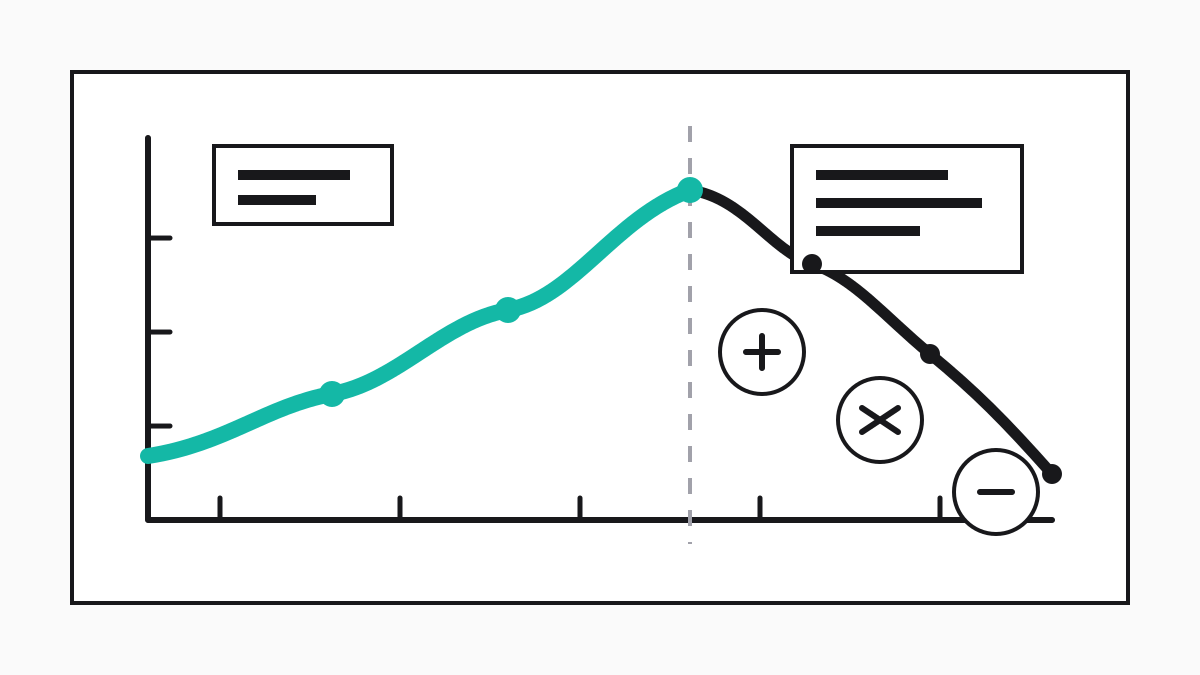
Many strategies look like stable money printers in backtests and start leaking as soon as they go live. During research, the equity curve is smooth, maximum drawdown is controlled, and win rate looks attractive. In live trading, slippage is larger than expected, orders fill incompletely, signal frequency changes, and losing streaks arrive faster than the report suggested. Researchers often blame "the market changed" or "bad luck."
But most backtest failures are not sudden. They were already embedded before launch. The backtest report simply failed to expose them. A backtest is not meant to prove a strategy will make money. It is meant to discover early where a strategy should not be traded. If a backtest only outputs return, win rate, and an equity curve, it has not done the real job.
When a strategy fails after launch, it is usually not because the future was unpredictable. It is because the past was cleaned too aggressively.
Backtests Assume Fills; Live Trading Tests Fills First
One of the most dangerous backtest assumptions is that after a signal appears, the strategy can fill at an ideal price. Many frameworks default to the next candle open, the current close, or a fixed slippage assumption. That makes a strategy look much more stable than real execution. In live trading, fill price is not an input. It is part of the strategy outcome.
Market orders have impact cost. Limit orders have non-fill and adverse-selection risk. Stop orders can slip far during violent moves. Breakout orders may chase into the thinnest part of the book. If each trade only earns a thin edge, slightly larger execution error can turn positive return into negative return.
This is especially true for short-horizon strategies. Theoretical edges are often only a few basis points. Under-counting half the fee, underestimating one tick of spread, or ignoring partial fills can create false stability. What looks like strategy skill may simply be execution cost not fully deducted.
Before live trading, ask at least four questions: is order-book depth sufficient when signals fire, how many price levels does the target position consume, does the system chase if limit orders do not fill, and what is the maximum acceptable slippage after a stop triggers? Without answers, even a good equity curve is only a paper result.
In-Sample Tuning Teaches A Strategy To Remember History
Many backtests do not validate hypotheses. They search for the most comfortable historical parameters. Dozens of moving-average windows, stop percentages, and filters are tested, and the final configuration is the one with the highest return and lowest drawdown. This looks rigorous, but it is teaching the strategy to memorize the past.
The difficult thing about overfitting is that it does not always look absurd. Some overfit strategies have plausible explanations and can pass part of an out-of-sample test. But once the researcher repeatedly checks results and modifies rules, the so-called out-of-sample data is contaminated. You are not seeing adaptation to the future. You are seeing the research process pull future data into training.
A simple check is the parameter neighborhood. If changing a parameter from 48 to 50 and from 50 to 52 keeps the strategy acceptable, it may depend on a stable structure. If only one exact parameter makes money and nearby values lose, it looks more like a narrow point in historical noise.
Another check is rule count. Entry, filters, stop-loss, take-profit, trading session, universe selection, volatility conditions, and volume conditions all add degrees of freedom. The more layers there are, the stricter the falsification tests must be. Otherwise the strategy is not capturing market structure; it is capturing the researcher's selection path.
Optimistic Cost Assumptions Can Consume The Entire Edge
Many strategies earn very thin average profit per trade. A trade may average 0.12%, which can annualize well, but if fees, spread, slippage, and funding together are 0.08% higher than expected, live return changes completely. The higher the frequency, the less vague cost modeling can be.
Costs should not be one fixed percentage. Real costs vary by market state. Spreads widen when volatility rises, impact cost rises when liquidity falls, stop slippage expands during news, and leveraged contracts are affected by funding rates. A fixed cost assumption can be a starting point, but it should not be a launch basis.
A more conservative approach is cost stress testing. Fees should use the real account tier; slippage should be tested at 1x, 1.5x, and 2x; lower-than-expected fill rates should be tested; funding rates should include extreme phases. If the strategy only works under the most optimistic cost scenario, the edge should not be treated as tradable.
Cost stress-test conclusions should become actions. If doubled slippage turns return negative, restrict order types and trading frequency. If drawdown loses control below 70% fill rate, monitor minimum fill rate. If extreme funding-rate percentiles worsen returns, write them into the filter.
Signals May Be Looking Into The Future
Look-ahead bias is not always obvious. It often appears in reasonable-looking details: using the close of an unfinished candle, opening on the same day with data known only after the close, computing percentiles on the full sample before backtesting history, selecting only assets alive today, or training on trend periods confirmed after the fact.
These problems do not throw code errors or mark themselves on the equity curve. They only make the strategy look smarter. In live trading, signals can only use information already confirmed at the time. In a backtest, knowing even a little future information improves win rate, drawdown, and entry placement.
Timestamps are the first defense. Signal generation time, data availability time, order time, and fill time must be separated. A daily strategy cannot assume it trades at the close before the close is confirmed. A minute strategy cannot treat the current changing candle as completed data. A factor strategy cannot use a future-cleaned universe.
A practical rule is that every field must answer: was this known at the time? If the answer is uncertain, treat it as unknown. It is better for the backtest to be conservative than for the strategy to go live with future information.
The Strategy May Only Fit One Market Regime
Some strategies are not invalid; their valid range is simply narrow. Trend strategies profit in strong trends and get stopped repeatedly in ranges. Mean-reversion strategies work in stable ranges and suffer tail losses in one-way markets. Breakout strategies depend on repricing after volatility contraction and get worn down in false-breakout environments.
If the backtest sample mainly comes from one regime, the strategy may fail after launch when it meets another. The problem is not that the market changed. The problem is that the research report did not explain which environment the strategy depends on or what actions follow when the environment changes.
The backtest report should split returns by environment. Trend strength, volatility percentile, volume change, market direction, and correlation level can all become slices. A strategy does not need to profit everywhere, but it should earn money where it claims to have an edge and lose less or trade less where it does not.
If a trend strategy's main profit comes from range-bound periods, question the hypothesis. If a mean-reversion strategy's largest losses all come from one-way breakouts, stops and pause conditions must be explicit. Regime decomposition is not for making a strategy look better. It is for knowing when not to let it work.
Profit May Be Concentrated In A Few Trades
Total return hides many problems. A strategy may have high annualized return, but if most profit comes from three trades or one month, its stability is weaker than the equity curve suggests. Live trading may not repeat those extreme winners, but it will repeat trading costs and loss volatility.
Before launch, inspect trade distribution. Does the strategy remain profitable after removing the largest 1% of winners? Is the losing streak within acceptable range? Are monthly returns overly concentrated? Does single-trade loss have a long tail? Is holding time consistent with the hypothesis? These reveal more real risk than one Sharpe ratio.
You can also perturb trade sequence. Keep each trade's P&L unchanged, randomly shuffle the order, and observe possible maximum drawdown. If original drawdown is much lower than most shuffled outcomes, the historical sequence may have been lucky. Live trading will not guarantee winners arrive exactly when needed.
If a strategy depends on a few large winners, it is not necessarily untradable, but position size and expectations should be lower. It needs a longer validation period, stricter stops, and clearer capacity limits, not leverage based on attractive annualized return.
Without Failure Monitoring, Losses Become The Alert System
Many strategies launch with entry and exit rules but no failure rules. After losses occur, researchers start asking: is this a normal drawdown or a broken strategy? Is it a regime shift or worse execution quality? Is it short-term noise or an invalidated hypothesis?
Without failure monitoring, the strategy becomes belief. As long as losses are not unbearable, researchers can always find a reason to keep trading. A mature system should reduce risk when anomalies first appear, not wait for account drawdown to decide.
Failure monitoring can start with four categories. Performance metrics: recent 30-trade win rate, payoff ratio, and maximum losing streak relative to historical ranges. Execution metrics: slippage, fill rate, rejection rate, and order latency. Signal metrics: signal frequency, holding time, and maximum adverse excursion after entry. Environment metrics: volatility, correlation, trend strength, and liquidity.
Each metric should map to an action. If slippage exceeds the backtest 95th percentile, halve position size. If signal frequency stays below the historical 5th percentile for two consecutive weeks, pause new entries. If realized drawdown exceeds 1.25 times stress-test drawdown, move to manual review. If orders fail repeatedly, switch the system to reduce-only mode.
Minimum Pre-Live Checklist
A strategy does not need to be perfect before small-capital validation, but it should pass a minimum checklist. The checklist is not meant to slow deployment. It is meant to keep obviously fragile systems away from real accounts.
- Hypothesis: explain why the market offers the opportunity and what invalidates it.
- Data: timestamps, missing values, unfinished candles, future data, and universe selection must be traceable.
- Costs: fees, spread, slippage, funding rates, and fill rate need stress testing.
- Parameters: nearby parameters should not collapse immediately, and rule count should match sample size.
- Distribution: profit should not depend excessively on a few trades, months, or one market state.
- Environment: returns should be decomposed by trend, range, volatility, and liquidity.
- Execution: order types, timeouts, partial fills, stop failures, and API anomalies need handling rules.
- Failure: pause, reduce, review, and recovery conditions must be written before launch.
If a strategy cannot pass these checks, the issue is not merely that it cannot go live yet. It is that the researcher does not know where it will break. The real danger is not that a strategy has flaws. It is that the flaws have not been named.
The Value Of A Backtest Is Exposing Failure Early
A good backtest does not make a strategy look more perfect. It makes the strategy look more constrained. It tells you which profits are unreliable, which costs consume the edge, which environments should not be traded, which execution conditions must hold, and which anomalies should trigger a stop.
That is less attractive than an upward equity curve, but it is closer to real trading. Live trading is not a continuation of the backtest. It is where backtest assumptions get tested. The more you dissect before launch, the less you pay in account balance after launch.
So the answer to "why did my backtest fail as soon as it went live?" usually lies before launch, not after it. The strategy already told you it was fragile. The backtest report simply did not listen carefully.
Comments
Loading comments.