Quant Trading
Spotting Backtest Overfitting: Why Beautiful Curves Are Dangerous
The smoother a backtest curve looks, the more you need to inspect sample selection, parameter freedom, trading costs, out-of-sample behavior, and real execution constraints.
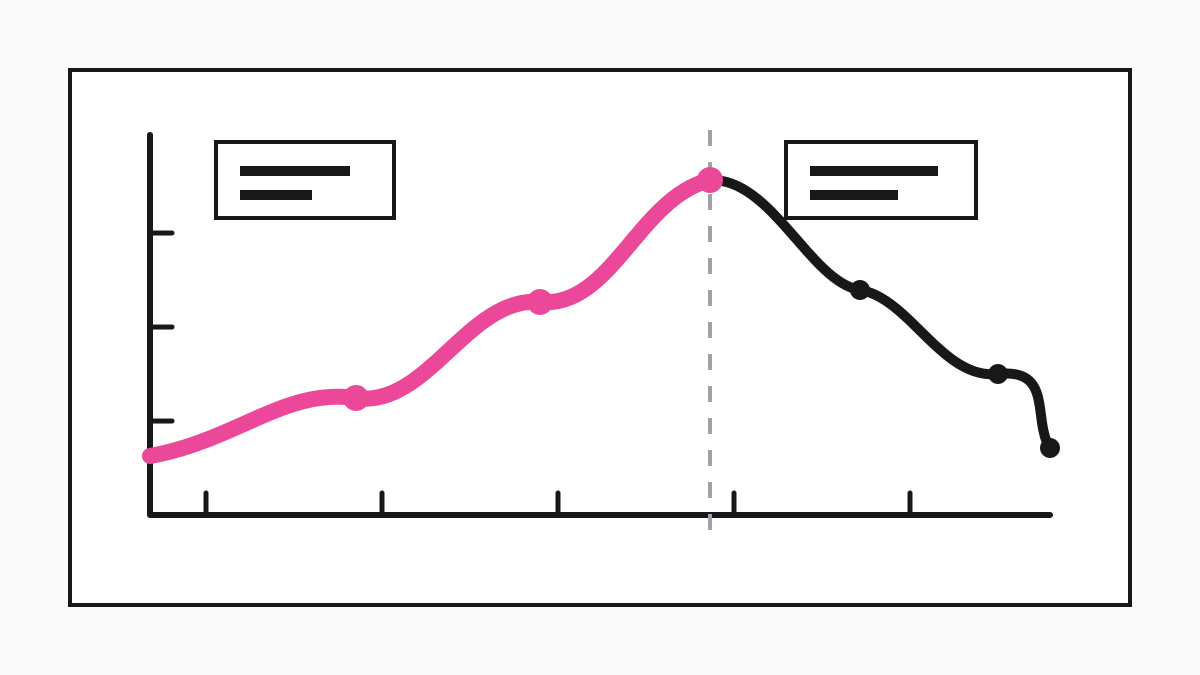
The easiest trap in quantitative trading is that backtests can look excellent. With enough parameters, enough filters, and enough flexible sample splits, it is almost always possible to find an equity curve that rises smoothly to the upper right. But that curve is often not strategy skill. It is the research process mistaking historical noise for a pattern.
Overfitting is dangerous because it looks professional. The curve has annualized return, the report has a Sharpe ratio, the parameters have optimization results, and there may even be dozens of charts. But if the research process allows repeated trial and error, repeated filtering, and repeated deletion of inconvenient samples, the final output is not a market law. It is the fingerprint of one historical dataset.
The more a backtest looks like a perfect answer, the first question should be: did the market give this answer, or did the researcher tune it into existence?
More Parameters Mean More Degrees Of Freedom
The core of overfitting is not the use of complex models. It is that the strategy has too many degrees of freedom. Entry indicators, exit indicators, stop-loss percentages, take-profit percentages, trading sessions, filters, instrument selection, and leverage all add another chance to fit history.
A simple check is parameter stability. If a slight move up or down in a parameter makes returns collapse, the strategy probably has not captured a stable structure. It has landed on a narrow point in the historical sample. Real markets will not keep running according to the best parameter you optimized.
Parameter stability does not require every nearby parameter to make the same profit, but adjacent regions should behave reasonably. If moving average windows of 48, 50, and 52 are all acceptable, the strategy may depend on a real trend structure. If only 51 makes money while 50 and 52 lose, it is more likely to be historical noise.
Sample Selection Also Creates Illusions
Overfitting does not only come from parameters. It also comes from sample selection. Choosing only rising periods, only surviving assets, only the most liquid pairs, or excluding extreme events can all make a strategy look more robust. In universe backtests, if you keep only assets that still exist today and have performed well, you have already introduced survivorship bias.
Time splits can also be abused. If the researcher looks at the full history first and then chooses a "representative" training and validation window, the split already contains hindsight. A safer approach is to define the sample range and split method before research starts, and reserve a final validation set that is genuinely untouched.
- Survivorship bias: failed, delisted, or liquidity-starved instruments are excluded.
- Look-ahead bias: the backtest uses financial reports, constituents, funding rates, or closing data that were not yet known.
- Data snooping: out-of-sample results are viewed repeatedly, then rules are adjusted until they look good.
- Single-regime data: training and validation both come from the same rising, low-volatility, or high-liquidity environment.
These biases have one thing in common: they do not label themselves on the return curve. The researcher sees a beautiful result without seeing how many real-world failure paths were left out.
Out-Of-Sample Behavior Matters More Than In-Sample Return
An in-sample backtest only shows that a strategy can explain the past. It does not show that it can trade the future. A more reliable process freezes the strategy logic and parameters first, then tests them on data that did not participate in research. If in-sample performance is excellent and out-of-sample performance decays sharply, assume overfitting exists instead of tuning until the out-of-sample period looks good too.
Time splits should also respect market regimes. You cannot train only on rising markets and validate on another rising market, and you should not treat adjacent windows as fully independent samples. A strategy should face trend, range, high volatility, low volatility, and liquidity changes before robustness is seriously discussed.
Out-of-sample decay does not always mean the strategy has no value. Real strategies usually lose some performance when they move from research to live trading. The question is whether the discount is explainable, inside the risk budget, and consistent with the hypothesis. If losses occur in environments the strategy was never meant to handle, filters may help. If every environment decays, the core hypothesis may not exist.
Costs Can Consume A Thin Edge
Many high-frequency strategies look good before costs. Once fees, slippage, order-book depth, and funding rates are included, the edge disappears. In crypto and derivatives markets especially, execution quality is part of the strategy result. It cannot be passed over with an optimistic fixed assumption.
Cost modeling should be conservative. Market orders need impact cost, limit orders need non-fill and adverse-selection assumptions, stop orders need gap risk, and leveraged positions need liquidation boundaries. If a strategy only works under extremely low cost assumptions, its real edge may not exist.
Cost stress testing can be direct: raise fees and slippage by 25%, 50%, and 100%, then observe return, drawdown, and trade count. If a strategy quickly moves from high return to loss, the edge is too thin. Thin edges can be traded, but only with strong execution and strict capacity control.
Inspect Trade Distribution, Not Just Final Return
Overfit strategies often concentrate profit in a few trades, or one short window contributes most of the return. A smooth equity curve does not guarantee a healthy trade distribution. Researchers should inspect single-trade P&L, maximum losing streak, monthly returns, returns across volatility environments, and performance after removing the largest winners.
If the strategy is no longer profitable after removing the top 1% of winning trades, it may depend on rare events. If losing streaks are far shorter than realistic levels, the sample may be too short. If return comes from one special year, the strategy may not have cross-cycle ability.
A useful falsification method is to decompose the source of returns: which trades made money, which months lost money, which market environments worked, and which instruments worked. The more a strategy depends on a single source, the more position size and expectations should be reduced. A tradable strategy does not have to profit in every phase, but both its profits and losses should be explainable by mechanism.
Use Stress Tests To Break The Beautiful Curve
The purpose of stress testing is not to make a strategy survive every extreme condition. It is to understand where it breaks. You can delay signals by one candle, widen slippage, reduce fillable quantity, randomly drop some orders, or restrict new entries during high volatility. If a strategy is extremely sensitive to small disturbances, it is not ready for live trading.
You can also perturb trade order. Keep the distribution of single-trade returns unchanged, shuffle the order randomly, and observe the possible range of maximum drawdown. If the original backtest drawdown is far below common shuffled outcomes, the historical sequence may have been lucky. Live trading will not guarantee that losses arrive in the same gentle order.
A stress-test report should produce actions, not only charts. For example: if doubled slippage remains acceptable, keep the strategy; if fill rate below 70% breaks it, monitor minimum fill rate; if trade-order perturbation shows possible 25% drawdown, the original 10% drawdown should not be used as the real risk budget.
Make Falsification A Fixed Process
Avoiding overfitting cannot rely only on experience. It needs a fixed falsification process. Before going live, every strategy should pass parameter perturbation, out-of-sample validation, cost stress testing, signal-delay testing, instrument replacement testing, and extreme-regime replay. Passing these tests does not guarantee profit, but it filters out many ideas that only explain history.
- Freeze hypotheses and parameters before opening out-of-sample data.
- Validate under conservative costs before discussing return.
- Inspect trade distribution before trusting total profit.
- Define failure conditions before moving to small live capital.
The purpose of a backtest is not to prove you are smart. It is to find out where you are wrong as quickly as possible. The earlier you take apart a beautiful curve, the less you pay for illusions in live trading.
Comments
Loading comments.