Quant Trading
The Quant Strategy Research Loop: From Idea To Tradable Rules
Quant research is not about throwing indicators into a backtest. It is about putting market hypotheses, data constraints, trading costs, and failure conditions into one validation process.
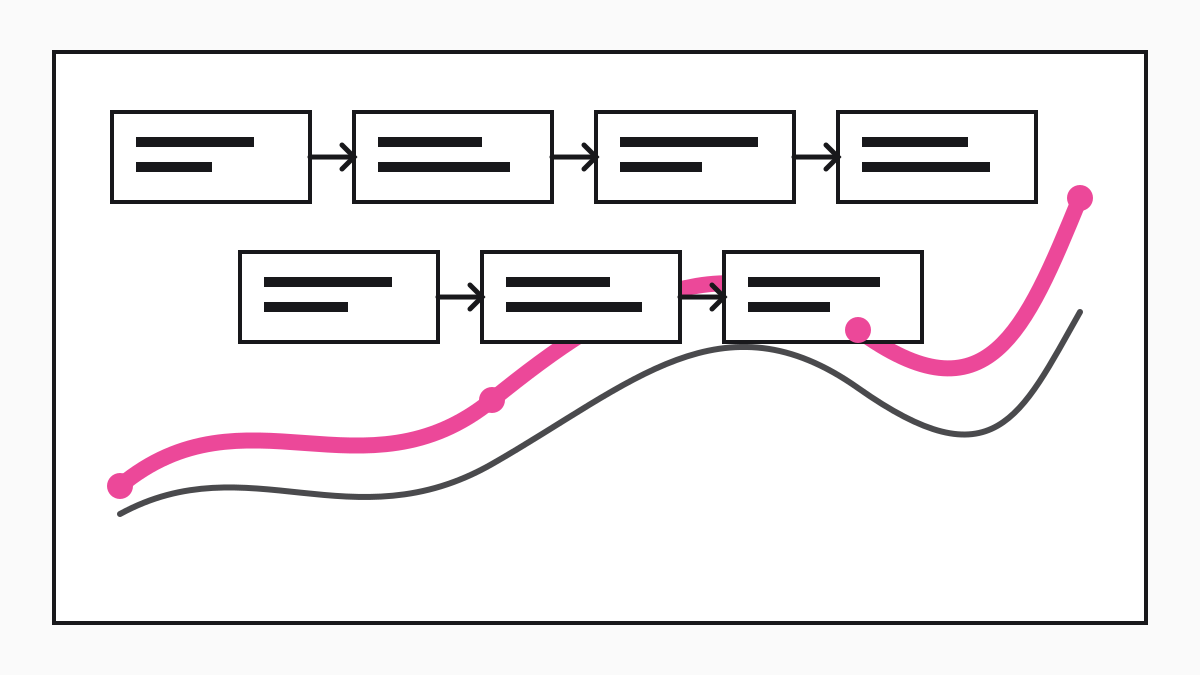
Many quantitative strategies fail not because the model is too simple, but because the research process has no closed loop. A trading idea that cannot be clearly expressed as a market hypothesis, observable variables, entry conditions, exit conditions, and failure conditions is not yet a strategy. It is intuition. Intuition can be the starting point, but it should not become position risk directly.
The point of a closed loop is that every step can be challenged with evidence. The hypothesis explains why a tradable market structure may exist. Data defines what can actually be observed. Backtesting studies how rules behaved historically. Out-of-sample testing and small live capital expose execution gaps. Monitoring and review judge whether the strategy remains inside its original zone of validity.
A good research process is not designed to prove that a strategy must make money. It is designed to discover faster when it should not trade.
Write The Hypothesis Before The Code
Strategy research should start with a one-sentence hypothesis. For example: pullbacks in strong trends are more likely to continue in the original direction; volatility contraction after high volatility raises breakout probability; when funding rates are extreme, contrarian risk-reward may improve. The more specific the hypothesis, the clearer the validation target and the clearer the abandonment point.
Starting directly from indicators is dangerous. Moving averages, RSI, Bollinger Bands, and volume factors are measurement tools, not trading reasons. If the research log only contains parameter combinations without a market mechanism, even a beautiful backtest is hard to interpret. It may capture a real phenomenon, or it may fit historical noise.
A stronger hypothesis includes four parts: why market participants create the phenomenon, which observable variables should reveal it, which environments make it more likely, and which environments should invalidate it. Without the last part, research easily becomes a search for supporting evidence.
"Breakout strategies work" is too broad. A more testable version is: after a long low-volatility contraction with shrinking volume, an upside range breakout accompanied by recovering volume may indicate repricing of positions; if follow-through volume is absent, or broad market volatility suddenly rises, the hypothesis weakens.
Data Quality Sets The Research Ceiling
The most common hidden errors in quant research are data problems. Whether candles include unfinished periods, whether volume definitions are consistent, whether contract rolls are handled, whether fees and slippage are understated, and whether delisted or suspended assets are missing all affect whether a backtest looks more stable than real trading.
A conservative approach is to build a data checklist first: timestamps are monotonic, missing values are recorded, extreme prices have sources, trading costs use the real account fee tier, and signals only use information known at that time. If any item fails, the backtest should not move into return discussion.
- Timestamp checks: duplicates, gaps, disorder, timezone drift, and unfinished candles.
- Price checks: whether highs are below lows, closes fall outside high-low ranges, and abnormal jumps have exchange sources.
- Cost checks: fees, funding rates, slippage, spreads, and minimum order sizes under real account rules.
- Information checks: whether factors use future data and whether sample filters include outcomes known only later.
The hard part about data problems is that they usually do not throw errors. The program runs, the backtest outputs a curve, and the researcher receives a seemingly rigorous conclusion. A rigorous process catches these errors before the backtest, not after a live strategy loses money.
Split Rules Into Auditable Modules
Tradable rules should not be an opaque pile of if-else logic. A better structure separates the strategy into signal, filter, sizing, exit, and risk-control modules. Signals describe opportunity. Filters judge environment. Sizing converts opportunity into risk exposure. Exits define error and realization. Risk controls limit system-level losses.
This structure reduces research confusion. If a trend strategy performs poorly, is the trend signal invalid, the filter too narrow, or the stop distance poorly matched to volatility? If all logic is mixed together, the researcher can hide problems through parameter tuning. Modular records give each change a clear purpose.
Strategy logs should also be recorded by module. For each trade, you should be able to answer: why did it enter, which filter passed, how was size calculated, what was the expected risk, why did it exit, and what was the actual slippage? Without these fields, review remains stuck at "this trade lost" and "that trade won."
A Backtest Is Not A Screenshot Of Return
A good backtest should answer at least four questions: which market phases generated returns, which environment produced maximum drawdown, whether single-trade distribution depends on a few extreme samples, and whether small parameter changes remain acceptable. Looking only at annualized return and win rate can package many fragile strategies as stable systems.
Return attribution is more useful. Trend strategies should earn money in trending periods and lose less in range-bound periods. Mean-reversion strategies should profit after excessive deviation and control losses in one-way markets. If a strategy earns money in phases inconsistent with its hypothesis, the researcher should question the research before rushing to deploy.
A backtest report should include at least the equity curve, drawdown curve, monthly returns, holding-time distribution, single-trade P&L distribution, maximum losing streak, cost sensitivity, parameter perturbation, and out-of-sample behavior. The fewer the metrics, the easier it is to be misled by one beautiful number.
For example, a strategy with 60% annualized return and 12% maximum drawdown looks good. But if 80% of profit comes from three trading days, removing the top three winners turns return negative, and a 30% cost increase lowers Sharpe from 1.8 to 0.4, it looks more like an event bet than a stable trading system.
Out-Of-Sample Validation Must Freeze Rules First
The key to out-of-sample validation is not merely running on a new period. It is freezing rules before seeing the result. The researcher must lock indicators, parameters, universe, cost assumptions, and risk rules before opening data that did not participate in research. If the out-of-sample result is poor and you keep modifying until it improves, that data has become new in-sample data.
Time splits should not be mechanical either. Financial data has strong regime characteristics, and adjacent periods are not fully independent. A strategy may work in low-rate, high-liquidity, one-way rising markets, but fail during tightening, sideways markets, and rising volatility. Validation should cover different market states, not only a recent favorable stretch.
Rolling validation can also help: train or select parameters on one period, test on the next, then roll forward. It cannot eliminate overfitting, but it exposes stability across windows. If only one window is outstanding, confidence should be reduced.
Put Failure Conditions Into The Strategy
Failure conditions must be defined before launch. A failure condition is not one losing trade. It is a signal that the strategy hypothesis is being structurally damaged: trading costs rise materially, signal frequency drops abnormally, slippage stays above backtest percentiles, related market structure changes, or multiple out-of-sample windows deviate from expectations.
Without failure conditions, a strategy becomes a belief system. When it loses, you do not know whether it is a normal drawdown, a regime shift, or a broken strategy. Quant trading needs automation not only for orders, but also for risk exposure, abnormal metrics, and research-hypothesis monitoring.
Failure conditions should preferably become thresholds and actions. If the average slippage over the latest 30 trades exceeds the backtest 95th percentile, halve position size. If signal frequency is below the historical 5th percentile for two consecutive calendar weeks, pause new entries. If realized drawdown exceeds 1.25 times stress-test drawdown, move to manual review.
Small Live Trading Is Part Of Research
There is always distance between paper backtests and real execution. Small live trading is not for quick profit. It is for exposing latency, slippage, fill rate, API errors, risk-control triggers, and human intervention. Only after these issues become visible does a strategy enter full validation.
The small-live phase should have a narrow goal. Do not frequently modify strategy logic while also validating execution quality, or you will not know whether results came from market behavior, code, execution, or human interference. A better approach is to keep rules stable and record the order lifecycle: signal time, order time, fill time, cancellation reason, average fill price, expected price, and actual cost.
A mature research loop usually looks like this: hypothesis record, data validation, initial backtest, robustness testing, out-of-sample validation, small live trading, monitoring, and review. Every step should leave traceable records. Quant trading's advantage is not being right forever. It is finding errors earlier, locating them faster, and fixing them at lower cost.
Comments
Loading comments.