Macro Markets
A U.S.-Iran War Gets Real at the Gas Pump
The U.S. may hold the military advantage over Iran, but the Strait of Hormuz can turn a regional war into higher fuel prices, delayed cargo, strained alliances, and a domestic political problem.
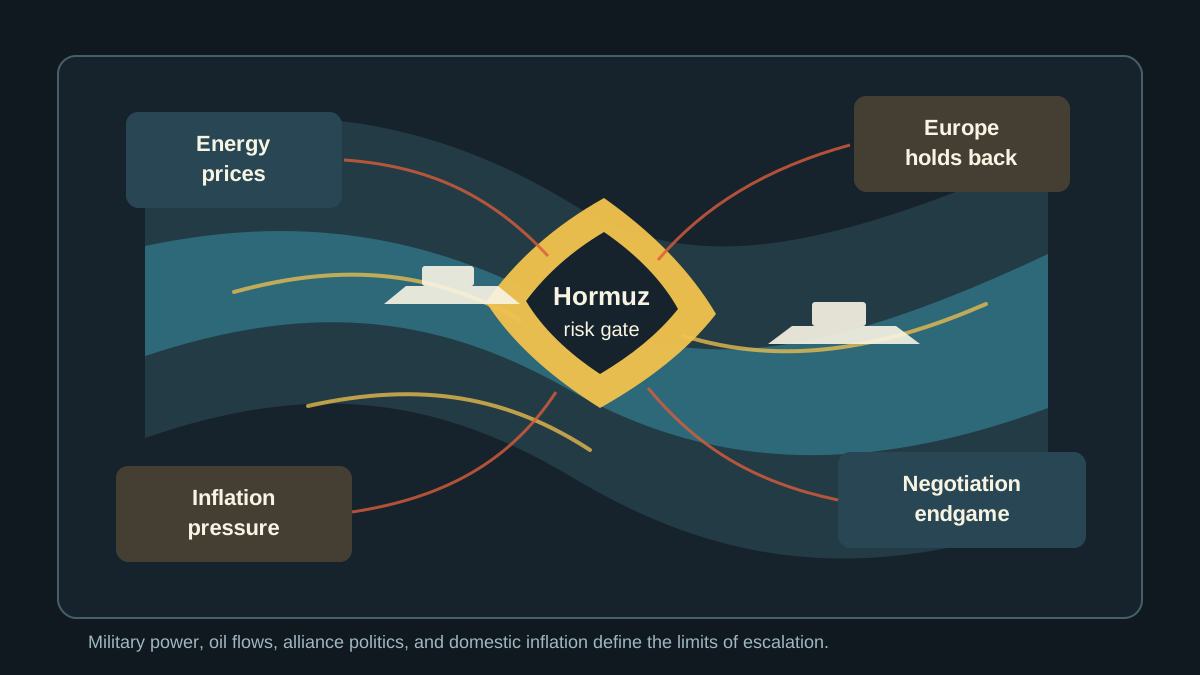
The most misleading sentence in any U.S.-Iran war would be: America has plenty of oil.
It is true in one narrow sense. The United States is a major producer, and Persian Gulf crude is a small share of U.S. imports. But that fact does not protect a driver in Ohio, a trucking company in Georgia, or an airline trying to price summer routes. Oil is a global market. When a key shipping lane breaks, the price moves everywhere.
That is why the Strait of Hormuz matters more than most Americans would like to admit. A war with Iran may begin as a military campaign, but it would become a price story almost immediately.
FactCheck.org put the U.S. exposure in useful perspective: in 2025, about 20 million barrels a day of crude and petroleum products moved through the Strait, and roughly 80% of those flows were bound for Asia. The U.S. imported only about 490,000 barrels a day of crude from Persian Gulf countries, about 8% of total U.S. crude imports. Yet after the conflict began, U.S. gasoline prices still rose sharply because crude prices are set globally.
That is the trap. Washington can say the war is happening far away. The gas pump will say otherwise.
Start With The Comforting Myth
The comforting version goes like this: the U.S. produces enormous amounts of oil, so a Hormuz crisis hurts China, India, Japan, and Europe far more than it hurts Americans.
There is some truth there. Asian buyers are more physically exposed to Gulf barrels. Europe has less room for another energy shock after the Russia-Ukraine war. The U.S. is much better positioned than it was in the 1970s.
Still, "better positioned" is not the same as insulated.
American refiners, airlines, truckers, farmers, retailers, and households do not buy oil from a private U.S. price universe. They live with Brent, WTI, diesel cracks, shipping delays, and global inventory anxiety. A producer in Texas may cheer a higher barrel. A family filling an SUV before work will not.
The EIA's April 2026 forecast shows how quickly this turns concrete. The agency estimated that Iraq, Saudi Arabia, Kuwait, the UAE, Qatar, and Bahrain collectively shut in 7.5 million barrels a day of crude production in March because flows through Hormuz were limited, with shut-ins rising to 9.1 million barrels a day in April. It forecast Brent to peak at $115 a barrel in the second quarter, retail gasoline near $4.30 a gallon in April, and diesel above $5.80 a gallon.
Those numbers are not abstract strategy. They are commute costs, freight invoices, farm inputs, airline fuel bills, and grocery prices.
Iran Does Not Need A Naval Victory
Iran's conventional military position is weak against the United States and Israel. That does not make Iran harmless.
Its leverage is risk. Not victory, not occupation, not a clean blockade maintained forever. Risk is enough.
A tanker detained for a few days changes behavior. A mine scare changes insurance. A drone attack changes routing. A credible threat changes the way traders price the next cargo before it leaves port. Markets do not wait for the Strait to be fully closed, photographed, confirmed, and footnoted. They pay for uncertainty in advance.
That is why the military question and the market question diverge. The U.S. can degrade Iranian military assets and still fail to make insurers comfortable. It can strike targets and still leave shipowners wondering whether a voyage needs an escort. It can announce success while refiners pay more for optional barrels.
In a Hormuz crisis, Iran's best weapon is not necessarily a missile. It is a delay.
The Second Bill Is Time
Oil prices get the headline, but time may do more damage inside companies.
A cargo that arrives late is not only expensive. It can miss a production window. A manufacturer that built its supply chain around lean inventories may have to carry more stock. A refinery may have to pay more for replacement barrels. A retailer may discover that the problem is not one higher shipping quote, but a series of uncertain delivery dates that forces more working capital into the system.
This is where the war leaves the oil screen and enters ordinary business.
Airlines face fuel costs first, then route decisions. Trucking companies face diesel costs. Chemical producers face feedstock costs. Food companies face energy in fertilizer, refrigeration, packaging, ocean freight, and trucking. Retailers face delivery and import costs just as households have less room for discretionary spending.
No CEO needs to announce, "Hormuz hurt us." The damage can arrive in smaller phrases: fuel headwinds, margin pressure, inventory normalization, pricing actions, softer demand.
That language sounds boring. It is how wars show up in earnings calls.
The Fed Would Hate This War
An oil shock is awkward for a central bank because it pushes in two directions at once.
Higher energy prices hurt consumers and growth-sensitive businesses. That argues for easier policy. Higher fuel and transport costs also feed inflation expectations. That argues against easing too quickly.
The Federal Reserve does not set oil prices. It does have to decide whether a temporary shock is becoming a broader inflation problem. A U.S.-Iran war would make that judgment harder, especially if diesel, jet fuel, and food costs remain elevated for more than a few weeks.
This is also where markets would split rather than simply panic. Energy producers and tanker operators may gain. Airlines, parcel carriers, retailers, automakers, chemical companies, and high-yield borrowers with thin margins may suffer. The stock index could hide a lot of pain underneath.
Credit desks would probably be less interested in slogans than in cash flow. Can the airline still cover debt service? Can the retailer pass through costs? Can an emerging-market borrower handle higher oil and a stronger dollar at the same time?
War is dramatic. Refinancing risk is not. Investors still care more about the second one.
Voters Notice Gasoline Before Strategy
Gasoline has a peculiar power in American politics. It is visible in a way most prices are not. It sits on street corners in giant numbers. People see it before they buy it. Local news repeats it. Politicians pretend not to obsess over it, then talk about it constantly.
That matters because a war's political clock does not run only through military progress. It runs through household irritation.
A short strike with a clear end point can survive a lot of criticism. A drawn-out conflict with expensive fuel, nervous markets, and vague objectives is harder to defend. Voters may support a tough line on Iran. They may also ask why the conflict is still lifting the cost of getting to work.
Food can become the quieter problem. Diesel, fertilizer, refrigeration, shipping, and packaging all sit behind grocery prices. A war does not need to cause a grain shortage to make dinner more expensive.
This is where the national-security argument meets the receipt.
Allies Will Ask What The War Is For
Europe's caution should be read through recent memory. European governments already spent political capital cushioning households and industries from the energy shock after Russia invaded Ukraine. A new shock through LNG, diesel, and chemical inputs would hit the same sore spot.
Asian governments would ask a different version of the same question. China, India, Japan, South Korea, and Southeast Asian economies care less about Washington's theory of regime transformation than about whether ships can move and whether import bills are stable.
This does not mean allies or partners have sympathy for Tehran. It means they will separate missions.
Keeping sea lanes open is one mission. Limiting nuclear risk is another. Weakening missiles and proxies is another. Regime change belongs in a different category. The wider Washington defines the goal, the harder it becomes to hold a coalition together once oil stays expensive.
That is why the war aim matters as much as the target list.
Regime Change Is Where The Bill Becomes Unlimited
The U.S. can describe limited objectives in concrete terms: damage nuclear and missile capacity, restore shipping, deter attacks on allies, and force a return to negotiations. Those goals are hard, but they can at least be measured.
Regime change sounds cleaner from a distance and messier up close.
What would count as success? A weakened Revolutionary Guard? A leadership reshuffle? A protest movement that survives repression? An opposition government with actual control? A unified Iranian state afterward? Each answer raises another question, and none comes with a cheap implementation plan.
The Middle East has already shown the gap between breaking a hostile regime and building a stable replacement order. The first task is military. The second is political, institutional, social, and expensive.
If oil is high and allies are nervous, regime change becomes even harder to defend. The U.S. may be able to win battles quickly. It cannot guarantee a low-cost political settlement afterward.
The Least Bad Ending Is Smaller Than The Rhetoric
The most plausible exit is not a grand victory. It is a limited bargain that lets each side claim something.
Washington would need to say Iran's nuclear and missile risks were reduced, shipping reopened, and deterrence restored. Tehran would need to say the regime survived, pressure eased, and some export or financial channels reopened. Europe would need energy prices to cool. Asia would need reliable sea lanes. Gulf producers may like firm oil, but they do not want the region's main export route permanently unstable.
That outcome would disappoint everyone who wants a clean ending. It may still be the only ending that fits the economics of the war.
Hormuz is a reminder that military superiority does not suspend market pricing. Facilities can be destroyed. Ships still need insurance. Oil still trades. Voters still buy gasoline.
If a U.S.-Iran war widens, the hardest question may not be whether America can win the battles. It may be how long Americans, allies, and global consumers are willing to pay for the strategy.
Sources
- FactCheck.org: How Iran Blocking the Strait of Hormuz Affects the U.S.
- U.S. Energy Information Administration: Hormuz closure and related production outages are key drivers in EIA's latest forecast
- USNI News: Congressional Research Service report on the Iran conflict and the Strait of Hormuz
- CSIS: Iran's Strait of Hormuz Gambit and the Limits of U.S. Military Power
- Al Jazeera / Reuters: European leaders reject military involvement in Strait of Hormuz
- The National: Oil tops $110 as stalled US-Iran talks stoke supply concerns
Comments
Loading comments.