Macro Markets
Stablecoins Are Not On-Chain Dollars. They Are Dollar Distribution Networks
Stablecoins matter because they turn dollars, Treasury bills, exchanges, wallets, payments, and DeFi into a high-velocity settlement network.
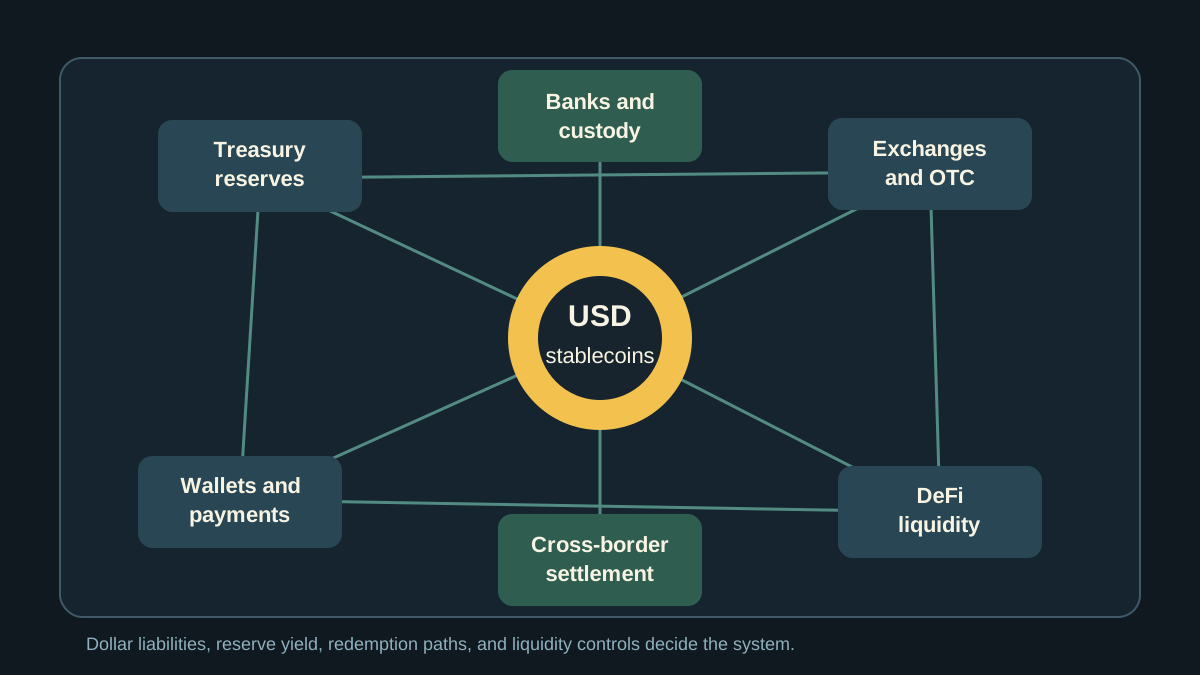
Stablecoins are often described as "on-chain dollars." The phrase is useful, but incomplete. A dollar is an asset. A stablecoin is a distribution network. It connects Treasury bills, bank deposits, exchange collateral, cross-border payments, on-chain lending, market-maker inventory, and user wallets into a near-24/7 settlement layer.
The important point is not only that one token tracks one dollar. The point is that dollar balances can move outside bank hours, regional account restrictions, and slow cross-border rails. Stablecoins are not mainly a rebellion against the dollar system. They are an external API for it.
Stablecoins do not create a new monetary order. They extend the reach, speed, and programmability of dollar balances.
Start With The Data
As of May 3, 2026, DeFiLlama showed total stablecoin market capitalization of roughly 321.759 billion dollars, up 1.56% over 30 days, with USDT dominance at 58.90%. That scale makes stablecoins more than a crypto trading convenience. They are now a shadow settlement layer linking dollar assets with global digital transaction demand.
Tether's own numbers show the structure clearly. In its Q1 2026 reserve update, published May 1, 2026, Tether reported about 183 billion dollars of token-related liabilities as of March 31, about 141 billion dollars of direct and indirect exposure to US Treasury bills, 1.04 billion dollars of quarterly net profit, and 8.23 billion dollars of excess reserves.
The implication is direct: the largest stablecoin issuer has become a large channel for short-dated US Treasury demand. Users hold a token, but the economic machinery underneath is Treasury bills, repos, bank balances, transaction fees, and liquidity management.
The Product Is Availability
Many investors assume stablecoin competition is mainly about yield. Yield attracts balances, but the real product is availability: where the token trades, who accepts it, which chains support it, how deep the liquidity is, whether wallets integrate it, whether market makers inventory it, and whether users can move it without waiting for a bank.
That explains USDT's persistence. It is not always the most transparent product, and it is not the cleanest regulatory story. But its network density across exchanges, OTC desks, Asia-facing liquidity, emerging-market settlement, and offshore trading is extremely high. Users often choose it not because they have a strong view on Tether's balance sheet, but because counterparties, venues, and liquidity already use it.
USDC is optimized for a different path: regulatory proximity, institutional onboarding, US financial-system connectivity, enterprise payments, and developer tooling. It is not simply copying USDT. It is embedding stablecoins into more formal commercial and financial workflows. The two giants map to two different demand pools: offshore dollar liquidity and regulated application integration.
Reserves Define The Risk
The right question is not only whether a stablecoin has one-to-one backing. The harder questions are what the reserves are, how long their duration is, who custodies them, whether they are segregated, how redemptions rank, and whether assets can be sold under stress.
Short Treasury bills and overnight repos are far more liquid than long-duration bonds, commercial paper, or private credit. But they still depend on custodians, settlement systems, legal structure, and banking access. A stablecoin can look simple on a wallet screen while depending on a complex off-chain operating stack.
Issuer economics are also straightforward. Stablecoin issuers earn mainly from reserve yield and service fees. When rates are high, an issuer can fund short-term Treasuries with non-interest-bearing or low-interest-bearing token liabilities. Tether's 1.04 billion dollars of Q1 net profit is the visible result of massive stablecoin liabilities sitting against high-yielding short-dated assets.
That is why regulation keeps tightening. Large stablecoin issuers increasingly resemble a hybrid of money-market funds, payment companies, offshore banks, and financial-market utilities. Reserve disclosure, redemption rules, AML controls, licenses, custody segregation, and bankruptcy treatment are no longer side topics. They are the product.
Stablecoins Strengthen Dollar Reach
Another common mistake is to treat stablecoins as an immediate threat to dollar dominance. In the near term, the opposite is more plausible. The largest stablecoins are dollar-denominated and backed largely by US dollar assets. They carry dollar balances into markets where traditional banking access is slow, expensive, restricted, or unreliable.
For many non-US users, stablecoins are not ideological. They are practical. Local currencies may be volatile. Dollar accounts may be difficult to open. International transfers may be expensive. Crypto exchanges settle in dollar-denominated assets. Stablecoins turn a dollar balance into something self-custodied, programmable, and portable across venues.
This has a dual effect on the US financial system. It expands global demand for dollars and short-term Treasuries. It also moves some deposit, payment, and cross-border settlement activity outside traditional banks. The dollar can become stronger while some banks become less central.
The Real Tail Risk Is A Liquidity Run
The most visible stablecoin risk is a price break below one dollar. The deeper risk is the redemption chain. A short secondary-market depeg can be arbitraged away if primary redemption, exchange liquidity, and market-maker balance sheets keep functioning. If many users try to exit at once and reserves, banks, custodians, or venues cannot absorb the flow, a price gap becomes a confidence crisis.
Runs usually come from three places. Asset-side shocks include reserve doubts, custodian stress, or Treasury-market liquidity problems. Liability-side shocks include exchange failures, enforcement actions, hacks, and concentrated user exits. Operating shocks include frozen transfers, delayed redemptions, bridge failures, chain congestion, and issuer controls.
That means stablecoin analysis should include the exit path. Who can redeem directly with the issuer? Do ordinary users rely only on exchanges? Can balances move during chain congestion? Does the issuer have multiple banking and custody relationships? These details decide whether a stablecoin behaves like money under pressure or like a risky asset priced near one dollar.
Compliance Will Centralize The Market
Regulation is often treated as bullish because it raises institutional comfort. That is true, but incomplete. Compliance also centralizes. Licensing, audits, custody rules, KYC, sanctions screening, reserve segregation, and reporting requirements raise fixed costs. Small issuers struggle. Large issuers and financial institutions gain advantage.
The stablecoin market is therefore unlikely to become a decentralized long tail. A more likely structure is a few global dollar stablecoins, some regional fiat stablecoins, a handful of regulated yield-bearing tokens, and specialized issuers serving particular exchanges or chains. Decentralized stablecoins will survive, but their scale will be constrained by collateral efficiency, liquidation risk, and regulated entry points.
This changes crypto market power. Whoever controls issuance, freezing, redemption, and cross-chain routing for major stablecoins controls key valves in on-chain dollar liquidity. The more successful stablecoins become, the less they look like pure crypto assets and the more they look like financial infrastructure.
How Traders Should Treat Them
For traders, a stablecoin is not risk-free cash. It is a dollar proxy carrying issuer risk, custody risk, chain risk, regulatory risk, and liquidity risk. In normal markets, those risks are hidden by a tight peg. In stressed markets, they become the main variables.
The practical answer is layered risk management. Split large balances across issuers and custody paths. Separate trading collateral from long-term cash. Avoid overdependence on a single bridge. Trace high-yield stablecoin products to their real yield source. If a token cannot be directly redeemed, treat secondary-market depth as part of the exit risk.
Stablecoins will not simply replace banks, and they will not retreat into crypto-native usage. They will expand in two directions at once: as the default dollar balance for trading and on-chain finance, and as a regulated settlement layer absorbed by traditional finance. The unresolved question is not whether stablecoins are useful. It is who controls the dollar distribution network, which rules govern it, and who takes losses when liquidity is tested.
Comments
Loading comments.