AI
AI's Bottleneck Is Moving From Model Capability To Capex And Inference Economics
Large-model competition is now an infrastructure cycle: GPUs, data centers, power, depreciation, utilization, and inference cost define the real boundary of AI commercialization.
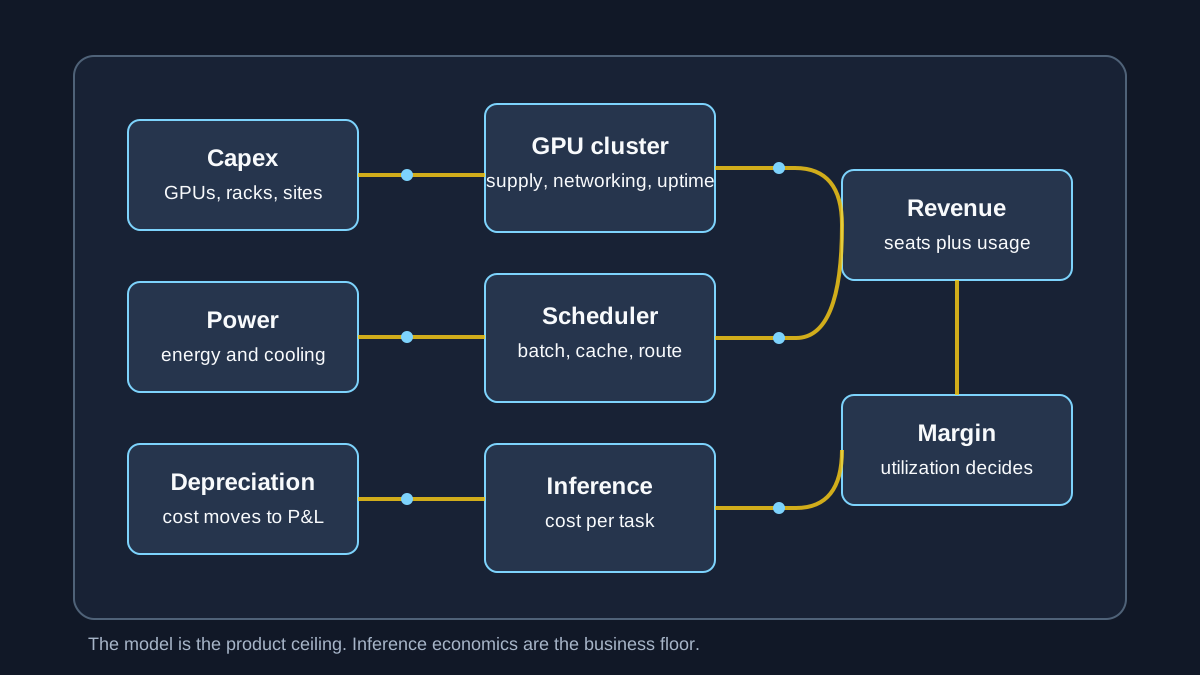
For several years, AI competition was framed mainly as model competition: parameters, context length, reasoning, coding, multimodality, and agents. That still matters, but it is no longer enough. By 2026, the bottleneck is shifting from "can the model do it?" to "can the service provide it cheaply, reliably, quickly, and at scale?"
Model capability sets the product ceiling. Capital expenditure and inference economics set the business floor. If every answer, image, code completion, search rewrite, and agent step consumes expensive compute, the real contest becomes cost per task, gross margin, data-center delivery, utilization, and demand forecasting.
The next AI race is not only about bigger models. It is about turning models into affordable, schedulable, billable, durable industrial services.
The starting point for this piece is that I no longer see AI mainly as a model-capability question. When the large cloud earnings reports are read together, the tension is clear: AI demand is real, but serving that demand requires expensive capacity to be built in advance. The question is not whether people will use AI. It is whether revenue growth can cover capex, depreciation, and inference cost.
The Tension Is Cash Flow, Not Revenue
The cloud earnings reports do not point to one simple conclusion. They point to three signals. Microsoft's FY26 Q3, the quarter ended March 31, 2026, had surpassed a 37 billion dollar AI annual revenue run rate, which says demand is no longer theoretical. Meta's Q1 2026 results raised full-year capex guidance to 125-145 billion dollars, which says supply requires heavy upfront investment. Amazon's Q1 2026 results showed trailing-12-month free cash flow down to 1.2 billion dollars, with pressure mainly from higher property and equipment purchases, which says growth can first show up as cash-flow strain.
That combination matters more than the company-by-company detail. AI revenue is rising, the infrastructure bill is rising with it, and cash flow is absorbed first by the buildout cycle. AI is no longer a light-asset software cycle. It is becoming a heavy infrastructure cycle driven by cloud capacity, chips, power, land, cooling, networking, and depreciation.
My view is that this is not simply an AI bubble. It looks more like an infrastructure expansion that combines pieces of the power grid, cloud computing, and semiconductor manufacturing. But that does not make every dollar of capex rational. The dangerous part of infrastructure cycles is that the long-term direction can be right while near-term capacity is built too early, too expensively, or in the wrong places.
Training Is The Ticket. Inference Is The Daily Cost
Training frontier models is expensive, but training is not the cost triggered by every user action. Inference is. Every prompt, customer-service answer, code suggestion, ad creative, search summary, and agent call consumes compute. The more successful the product becomes, the larger the inference bill becomes.
That makes AI commercialization structurally different from classic SaaS. Traditional software has low marginal cost. More users mostly mean bandwidth, storage, and support. AI products have harder marginal cost: tokens, memory, GPU time, network communication, power, cooling, and scheduler waste. Usage intensity turns into cost intensity.
So AI companies cannot be evaluated only by users and subscription revenue. The key variables are compute per user, model choice per task, cache hit rate, context length, latency requirement, and tool-call frequency. A high-frequency low-paying user can be less attractive than a lower-frequency enterprise workflow with clear willingness to pay.
The unit economics can be stated more plainly. A fixed-price AI product behaves like software if users ask occasional questions. It starts to behave like cloud infrastructure if users ask it to read long documents, write code, run agents, call tools, and regenerate outputs every day. Revenue is a relatively flat subscription line. Cost rises with usage intensity. That mismatch is why user growth is not automatically good news in AI products; it has to be read alongside revenue per task, inference cost per task, and peak-capacity load.
Model Routing Becomes A Margin Tool
Mature AI products will not send every request to the largest model. They will route requests like trading systems route orders. Simple tasks go to small models. Hard tasks go to larger models. Low-value requests receive shorter context and lower reasoning depth. High-value workflows get the expensive path. Cacheable work is not recomputed. Batchable work avoids peak capacity.
That is the economic meaning of model routing. It is not a minor engineering optimization. It is a gross-margin tool. The ability to classify, compress, cache, batch, and route tasks determines how much profit remains from the same revenue.
Inference optimization spans many layers: distillation, quantization, sparsity, KV cache, speculative decoding, batching, low-precision compute, specialized inference chips, edge deployment, context trimming, and tool-use control. Each detail sounds technical. Together, they define the business model.
Data-Center Delivery Is A Competitive Advantage
AI companies used to fight mostly through papers and benchmarks. Now they also fight for power, racks, GPUs, networking, cooling, and data-center sites. Whoever converts capex into usable compute faster can train faster, serve customers sooner, reduce queues, and improve reliability.
This is why Nvidia keeps moving from individual accelerators toward full racks, networking, software stacks, and reference systems. Customers are not buying one chip. They are buying deployable compute capacity. GPU performance matters, but cluster stability, interconnect efficiency, failure recovery, driver maturity, and supply-chain delivery also matter.
The difficulty is that capex is partly irreversible. Data centers and GPU clusters must be ordered before demand is fully visible, while model efficiency, chip generations, customer budgets, and competition keep changing. Build too little and customers wait. Build too much and depreciation and free cash flow suffer. AI cloud providers are effectively trading capacity futures.
Depreciation Will Shape AI Pricing
AI infrastructure is not a one-time expense. GPUs, servers, networking gear, buildings, power systems, and cooling equipment depreciate. As capex rises, depreciation gradually moves through the income statement, pressuring margins and forcing higher utilization.
That means AI pricing cannot rely on subsidies forever. Free tiers, cheap plans, and "unlimited" usage eventually meet the compute bill. Enterprise plans, usage pricing, token pricing, task pricing, and seat-plus-consumption models will become more important. Customers want budget predictability; suppliers need cost pass-through.
The ideal AI business is not simply "more users." It is more high-value tasks. If usage growth comes mostly from low-value, low-paying, hard-to-monetize requests, scale can amplify losses. Healthy growth allocates compute to workflows with real willingness to pay.
Open Models Reset The Price Anchor
Open and open-weight models will keep lowering the price of baseline capability. Enterprises can deploy good-enough models in private clouds, on-prem GPU clusters, rented compute, or multi-cloud setups. That weakens closed-model pricing power for ordinary tasks and pushes commercial differentiation toward reliability, tooling, compliance, latency, context, data integration, and workflow embedding.
But open models do not eliminate infrastructure cost. They move cost from API bills into deployment, operations, rented GPUs, engineering staff, security, and governance. Many enterprises will discover that model weights are cheap; stable service is not.
So the moat for closed-model and cloud providers shifts from "our model is smarter" to "our total cost of ownership is lower." If managed services offer better reliability, compliance, scaling, and cost predictability, customers will still buy them. If API pricing is high, latency unstable, and data boundaries unclear, open-model substitution accelerates.
Investors Should Watch Cash Conversion
AI revenue growth matters, but cash conversion matters more. Capex, finance leases, depreciation, energy cost, GPU replacement cycles, utilization, and contract duration decide whether revenue becomes free cash flow.
A practical framework uses four questions. Is AI-related revenue growing faster than capex? Is cloud utilization improving, or is growth driven mainly by buying more GPUs? Is inference cost per task falling through efficiency gains? Are customers signing durable contracts, or is demand still experimental?
If those metrics improve, AI infrastructure can create scale economies. If they do not, capex becomes margin pressure. The most dangerous outcome is not zero AI demand. It is real demand with weak unit economics.
The failure case is also clear. Cloud providers build too much capacity before enterprise AI budgets arrive. Inference prices keep falling because of competition and open-model substitution, while high-quality service remains compute-intensive. Usage is strong, but too much of it sits in low-value, low-paying, hard-to-price workflows. In that scenario, the industry does not fail because nobody uses AI. It fails because many people use AI and suppliers still do not earn enough money.
If this view is wrong, it is probably wrong in two places. First, inference cost could fall much faster than expected as model compression, chip improvement, and scheduling efficiency push cost per task low enough to absorb the capex burden. Second, demand elasticity could be stronger than it currently appears: cheaper inference could create enough new use cases to fill data centers quickly. In that world, today's aggressive AI capex would look more like early cloud buildout than a breakdown in capital discipline.
AI Has Entered Its Industrial Phase
The first phase of AI competition was model capability. The second was product experience. The third is infrastructure economics. All three still matter, but their weights are changing. Models remain crucial, yet a larger model no longer automatically means a better business.
Future winners must answer three questions at once: can they train strong models, can they embed them into valuable workflows, and can they serve them with acceptable capex and inference cost? Missing any one of those makes the AI narrative distort inside the financial statements.
Future markets will not only reward "smarter." They will increasingly reward "cheaper smart." Model capability can still create the story. Cash flow determines how long the story can be told.
AI is not making software lighter. It is pulling energy, chips, real estate, and manufacturing intensity into software economics. The real dividing line will not appear in launch demos. It will show up in the cost of each inference call, the utilization of each data center, and the depreciation line on each income statement.
Comments
Loading comments.