AI
DeepSeek V4: Million-Token Context, Open-Source Frontier Models, and China's AI Stack Migration
DeepSeek V4 Preview is not just another model upgrade. It puts long context, reasoning modes, agent workflows, and domestic accelerator adaptation into the same technical story.
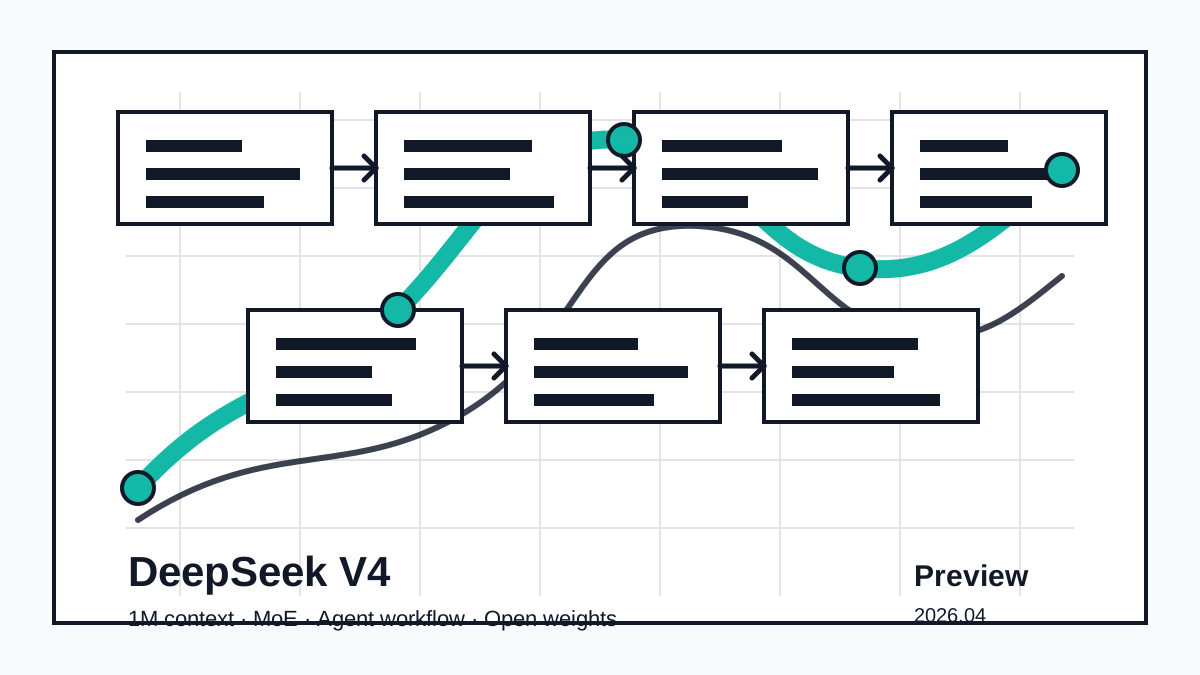
The value of DeepSeek V4 Preview is not that it adds another large-parameter model to the market. Its real significance is that it merges three stories that used to be separate: open-source models continue to approach the closed-source frontier, agents are replacing single-turn chat as the main battlefield, and China's AI stack is moving from "it can run" toward deeper optimization for domestic chips. If you only look at rankings, V4 is a model release. If you look at technology, pricing, hardware, and enterprise procurement together, it looks more like a public test of an infrastructure migration.
The weight of V4 cannot be judged only by launch messaging or benchmark placement. Three questions matter more. First, does it move long context from "demo-capable" to "usable at scale"? Second, does it turn agents from prompt tricks into part of model training and infrastructure? Third, does it show that China's AI stack is extending from the model layer into chips, cloud clusters, and developer tooling?
As of April 30, 2026, the confirmed facts are these: DeepSeek V4 remains a Preview Release; the official release includes Flash and Pro variants; V4-Pro has 1.6T total parameters and 49B activated parameters, while V4-Flash has 284B total parameters and 13B activated parameters; both are MoE models with support for a 1 million token context; the weights use the MIT License; and the Instruct model supports Non-think, Think, and Think Max reasoning modes. What should not be treated as established fact is the full training hardware setup, the true training cost, the share of Huawei chips used in training, or whether official benchmarks reproduce across all third-party scenarios.
The real point of V4 is not "DeepSeek caught up with someone again." It is that long-context economics, agent post-training, open weights, and domestic accelerator adaptation have become one systems problem.
What V4 Changes In Evaluation
V4 puts model capability, reasoning budget, context length, and hardware path into the same evaluation table. Enterprises are no longer only comparing which model answers better. They have to ask whether long context reduces retrieval and manual preparation cost, whether agents reduce rework, whether Flash/Pro/Think Max routing lowers total inference cost, and whether Ascend adaptation reduces future compute-supply risk.
That changes the order of model selection. A common process is to check leaderboards first, then price, then deployment. V4 is better evaluated in reverse: start with whether the task needs long context and tool use, then decide how Flash, Pro, and Think Max should be routed, and only then choose API use, private deployment, or domestic accelerator adaptation. The relevant competition is not a few points on a single-task benchmark, but the total failure cost of a complex workflow.
Three Threads Define V4's Weight
The first thread is the compute ecosystem. V4 did not only release new weights; it also pushed the relationship between DeepSeek and Huawei Ascend into public view. Public information shows that after V4's release, Huawei said its Ascend 950 supernode product line supports the DeepSeek-V4 series and that part of V4-Flash training used its chips. The important point is not the promotional wording, but the industrial structure: model launches are becoming coordinated events across chips, cloud services, inference frameworks, and developer ecosystems.
The second thread is software stack reconstruction. V4 was long expected, but the release cadence was slower than the market anticipated. One reasonable explanation is that DeepSeek was not satisfied with merely making the model "run on domestic chips"; it wanted deeper hardware-specific optimization. Migrating large models from Nvidia to Ascend is not only about operator compatibility. Throughput, communication, memory, compilers, frameworks, and fault tolerance all need to reach production readiness together.
The third thread is capability boundaries. V4 narrows the gap between open-source models and closed frontier models, but it is not yet a full replacement. It is currently text-only and does not handle images, audio, or video. On knowledge-heavy tasks, it is also unsafe to assume it has exceeded the latest closed frontier models. V4's stronger story is concentrated around open weights, pricing, long context, and agent or coding scenarios.
So V4 is not a single technical breakthrough. It is a systems-level bet. DeepSeek is betting that future model competition will not be decided only by single-turn answer quality, but by who can carry long tasks, tool use, private deployment, and hardware supply uncertainty at lower cost.
Why DeepSeek Has To Do This
DeepSeek's approach to V4 is essentially a way to avoid a war where it does not hold the strongest position. Closed-source giants are best at multimodal product portfolios, global cloud resources, massive commercial distribution, and continuous compute scaling. If DeepSeek tried to compete in the same way for the "strongest general assistant," it would quickly enter a battlefield where compute, ecosystem, and channels all become heavier. V4 chooses a different battlefield: open weights, long context, agents, private deployment, and domestic compute, where closed-source giants do not have complete control.
First, DeepSeek needs open weights to amplify its reach. It does not have the same global enterprise sales and cloud product entrances as OpenAI, Google, or Anthropic. Open source is its distribution channel. The MIT License is not only a technical posture; it is a growth strategy. It allows cloud vendors, startups, internal enterprise platforms, and hardware companies to adapt around V4. DeepSeek does not need to win every customer directly. If more infrastructure treats V4 as a default option, the model's influence spreads.
Second, it needs MoE and layered reasoning to ease compute constraints. Leading US labs can keep expanding training and inference clusters. Chinese model companies face harder constraints: high-end GPU supply, export controls, cloud resource prices, and the maturity of domestic chips are all uncertain. V4's Flash/Pro split and Non-think/Think/Think Max modes turn compute constraints into product structure. DeepSeek is not pretending compute is infinite. It is splitting tasks into different budget tiers so the model service can cover enough scenarios even when resources are not abundant.
Third, it needs to bet early on agents because chatbots are becoming less differentiated. Ordinary Q&A, summarization, translation, and writing are already highly commoditized. Users are unlikely to migrate platforms just because a single-turn answer is slightly better. Agents are different. They bind to code repositories, tool permissions, enterprise data, workflows, and execution results. Once they work, switching costs rise and commercial value increases. V4's investment in tool calling, cross-turn state, and sandbox training shows that DeepSeek is not only chasing the entrance for "answering questions"; it is chasing the infrastructure for "finishing work."
Fourth, it needs mutual validation with domestic chips. DeepSeek needs stable compute, Huawei Ascend needs flagship models, cloud vendors need a sellable domestic AI stack, and enterprise customers need lower supply-chain risk. V4 ties these interests together. The stronger the model, the more reason Ascend has for deployment. The more mature Ascend becomes, the more DeepSeek can reduce dependence on restricted compute. This is not a simple technical partnership; it is a mutual-support structure formed by China's AI supply chain under external constraints.
The deeper logic of V4 is therefore not "release a stronger model," but "move DeepSeek from model company toward ecosystem node." If it succeeds, DeepSeek will be more than a model supplier; it may become one of the de facto standards in China's AI stack. If it fails, it may still have strong models, but it will struggle to escape pressure from compute supply, closed-model iteration, and channel disadvantages.
Total Parameters Are Not The Main Story
V4-Pro's 1.6T total parameters easily become the headline, but the key to an MoE model is not "more total parameters is always better." The key is how many parameters activate for each inference step. V4-Pro activates about 49B parameters per token, while V4-Flash activates about 13B. Sparse activation separates model capacity from inference cost: the model can store a wider distribution of capabilities without using all parameters on every request.
This is also the product logic behind the Flash/Pro split. Flash is not simply a "small model." It is the version optimized for cost, latency, and throughput, suited to frequent, lower-risk, fault-tolerant tasks. Pro is for complex reasoning, coding, agents, and higher-value workflows. For enterprises, this layering is more realistic than expecting one strongest model to handle everything, because in real systems, 80% of requests are not worth the highest reasoning cost.
The MIT License further changes the commercial nature of the model. Many open models look downloadable, but licensing, commercial restrictions, weight availability, deployment documentation, and inference framework support can keep enterprises away. V4's MIT License makes private deployment, industry fine-tuning, model gateway integration, and internal agent-platform evaluation easier to put into procurement workflows. Of course, a permissive license does not make deployment simple. A 1.6T MoE model still has a high engineering bar.
The most important point here is not parameter scale. It is whether DeepSeek is trying to replicate a new open-model pattern: provide strong enough base weights, use MoE to control inference cost, expose reasoning modes as budget tiers, enter high-value scenarios through long context and agent post-training, then let cloud and hardware vendors adapt an ecosystem around it.
V4 Sells Schedulable Intelligence
Many model launches compress capability into one aggregate score: stronger model, lower price, longer context. Enterprise systems do not buy aggregate scores. They buy the ability to finish work reliably. The Flash/Pro split and the Non-think/Think/Think Max modes make intelligence schedulable. Lower-risk requests do not need the highest reasoning budget. High-value failures can be escalated. Long-context work can be designed together with retrieval, summaries, and tool calls.
This matters most for agents. Agent cost is not only token cost; it includes human takeover, reruns, environment cleanup, bad commits, and audit work after failure. If a coding agent misreads a log after six tool-call rounds, the earlier tokens are already spent and the final output may still introduce a new bug. V4 should therefore be judged by whether it reduces the total cost of completing a task, not by input and output token prices alone.
The official mode comparison supports this routing view. Flash is not only for trivial tasks: on SWE Verified, V4-Flash Non-think already reaches 73.7 resolved, Flash Max rises to 79.0, close to V4-Pro Max at 80.6. But Pro still has a much higher ceiling on knowledge-heavy and complex reasoning tasks; on SimpleQA-Verified, Flash Max reaches 34.1 while Pro Max reaches 57.9. Flash looks like the default layer for high-throughput workflows, while Pro is better treated as the escalation layer for high-uncertainty work.
Million-Token Context Is Really A Cost Problem
A 1 million token context is easy to market as the ability to fit an entire book, a repository, or a pile of contracts. But the hard part of long context is not the window limit. It is the cost. As context grows, attention computation, KV cache, memory use, latency, and error propagation all grow. If a model can handle 1M tokens only in demos, but cannot serve real agents at acceptable cost, it has limited production value.
One of DeepSeek V4's technical cores is its Hybrid Attention Architecture. Hugging Face's technical analysis says V4 alternates attention layers between CSA and HCA, uses DeepSeekMoE in feed-forward layers, and replaces traditional residual connections with manifold-constrained hyper-connections. CSA can be understood as sparse compressed attention for long context, while HCA further compresses historical information. The goal is to preserve long-range dependency while reducing computation and cache pressure.
The most important public number is this: in a 1M token setting, V4-Pro reportedly needs only about 27% of V3.2's single-token inference FLOPs and about 10% of its KV cache. This matters more than "supports 1M tokens." What determines whether long context can enter production is the cost curve for each additional token, not the maximum number printed on the model card.
Long context still has boundaries. The Hugging Face analysis says that in long-context retrieval, MRCR 8-needle accuracy remains above 0.82 at 256K tokens but drops to 0.59 at 1M tokens. This is a reminder that 1M context does not mean every detail inside 1M tokens can be recalled reliably. Engineering systems still need retrieval, segmentation, evidence marking, summary layers, and task-state management. Dumping all material into context usually only moves the retrieval problem inside the model, where it is harder to debug.
Agents Are V4's Most Important Application Assumption
V4 is aimed at agent frameworks such as Claude Code and OpenClaw. That detail carries more information than many benchmarks. DeepSeek does not only want V4 to answer questions. It wants V4 to read code, call tools, execute commands, handle errors, and return to context to continue fixing problems. Agent workflows demand very different capabilities from chat: long-running state, stable tool formats, error recovery, permission boundaries, and cross-turn consistency.
Hugging Face's technical analysis gives three more specific agent designs. The first is interleaved thinking across tool calls. V3.2 would discard earlier reasoning content when a new user message arrived; V4 keeps cross-turn reasoning history in conversations with tool calls, making long tasks more continuous. The second is the introduction of the |DSML| special token and an XML tool-call format, reducing common escaping failures in nested JSON strings. The third is the DSec sandbox, a Rust platform that unifies function calls, containers, Firecracker microVMs, and QEMU VMs to provide realistic tool environments for RL rollouts.
These designs show that V4's post-training target is not simply "solve tasks." It is to let the model learn action inside environments. The hard part of agents is not one answer; it is the trajectory. Can the model choose the right tool? Can it understand tool output? Can it recover from failure? Can it keep the goal stable as context grows? Can it handle multi-turn user intervention without resetting task state?
That is why V4-Pro-Max's results on agent benchmarks such as Terminal Bench 2.0, SWE Verified, MCPAtlas, and Toolathlon matter more than traditional knowledge scores. In public analysis, V4-Pro-Max reaches 80.6 resolved on SWE Verified, 73.6 on MCPAtlas Public, and 51.8 on Toolathlon. These numbers cannot replace real business testing, but they show DeepSeek has moved training and evaluation toward whether a model can complete work.
Three Reasoning Modes Are A Cost-Control Interface
V4's Instruct model supports Non-think, Think, and Think Max. On the surface, this is a switch for how deeply the model "thinks." More fundamentally, it exposes reasoning budget to the application layer. Enterprise systems do not need the smartest model all the time. They need models that allocate cost according to task risk.
Non-think fits low-risk, low-complexity, high-concurrency tasks such as summarization, classification, formatting, and simple Q&A. Think fits tasks that need planning, comparison, code changes, or strategy generation. Think Max is closer to a high-cost solving mode for difficult bugs, complex engineering migrations, critical decision support, or benchmarks. DeepSeek's model card also recommends at least 384K token context for Think Max, which itself shows that high-reasoning mode is not free.
This changes application architecture. In the past, many AI applications simply wrote "think step by step" in prompts and sent every request to the same model. V4's mode layering lets systems route requests first: low-value requests can go to Flash Non-think, medium-complexity requests to Flash Think, high-value or failed retries to Pro Think, and only a few critical nodes to Pro Think Max. The real cost advantage comes from this scheduling, not from a single model's list price.
For that reason, V4 should not be evaluated only by asking whether Pro-Max scores a few points higher than GPT or Gemini. Better questions are: how many daily requests can Flash cover? Does Pro significantly reduce human rework time? Is Think Max's marginal benefit worth its cost? Can the system degrade, retry, or escalate automatically after model failure? These are the real production questions.
The Industrial Meaning Of Huawei Ascend Adaptation
The relationship between DeepSeek V4 and Huawei Ascend is the part of this release that is easiest to overinterpret and hardest to ignore. The publicly verifiable information is that V4 has been adapted to Huawei chips; Huawei says Ascend 950-based supernode clusters support V4; and it says some V4-Flash training used its chips. At the same time, DeepSeek has not disclosed whether V4 also used Nvidia chips for training. These boundaries matter. "Supported" should not be confused with "trained entirely on domestic hardware."
If DeepSeek has indeed rebuilt parts of the software stack for Ascend, it means the task for China's AI industry has moved from "what do we do if we cannot buy the strongest GPUs?" to "how do we jointly optimize models, frameworks, chips, and cloud clusters?" The difficulty of hardware substitution is not only peak compute. It is ecosystem stickiness. Nvidia's barrier is not just chips; it is CUDA, kernels, communication libraries, debugging tools, developer experience, and cloud-service maturity.
But V4 is not only an Ascend story. NVIDIA has already placed DeepSeek V4 inside Blackwell, NIM, SGLang, and vLLM deployment paths, and reported initial V4-Pro tests above 150 tokens/sec/user on GB200 NVL72. That points to a dual-stack competition: in China, V4 gives Ascend a flagship workload; in the global developer ecosystem, the same open weights are also being absorbed quickly into NVIDIA's mature inference stack. For DeepSeek, that is strategically useful because model influence is not locked to one hardware path.
There are also demand-side signals. After V4's release, large Chinese internet companies and GPU rental or cloud-computing companies reportedly began seeking Huawei Ascend 950 AI chip orders. This suggests V4 may have become a catalyst for procurement decisions. Once a model proves it can serve high-value applications on domestic hardware, enterprises start recalculating supply security, compliance, cost, and long-term bargaining power.
Still, this requires caution. For the Ascend ecosystem to truly replace the Nvidia ecosystem, it needs to answer four engineering questions: Is multi-node communication stable? Can inference throughput hold under real concurrency? Can the software stack support new model structures quickly? Is developer migration cost low enough? Until these are verified at production scale, V4 is more milestone than end state.
What The Signals Actually Mean
The first signal is "Preview," not a final release. This wording is not just caution. It shows DeepSeek still needs real users and real workflows to complete the last stage of validation. For traditional chat models, Preview may be only a product cadence. For an agent and long-context model like V4, Preview is closer to a public stress test. DeepSeek needs to learn how the model fails in real repositories, real toolchains, real long documents, and real concurrency.
The second signal is the price gap between Pro and Flash services. V4 does not package "strongest capability" as one unified low price. It gives Pro and Flash different jobs. This shows DeepSeek clearly understands that high reasoning budgets and high-end compute remain scarce. Flash is the scaled entry point, Pro is for high-value scenarios, and Pro-Max demonstrates the ceiling. The real business strategy is not to make everyone use Pro-Max, but to let developers use Flash in most scenarios and escalate a small number of critical tasks to Pro.
The third signal is text-only. Many people will see this as a weakness, but it may also be a deliberate tradeoff. Multimodality is important, but it complicates training data, inference systems, product experience, and safety boundaries. DeepSeek prioritized text, code, tool calls, and long context this time, suggesting it cares more about enterprise and developer workflows than first winning the consumer all-purpose assistant narrative. This choice makes V4 look less complete, but it also makes its engineering focus tighter.
The fourth signal is the emphasis on agent benchmarks. Traditional model releases like to emphasize knowledge, math, and code, but V4's story clearly brings "can it finish the task?" to the foreground. Metrics such as Terminal Bench, SWE Verified, and Toolathlon focus on the model's execution trajectory inside an environment, not just single-question accuracy. This means DeepSeek has pushed the definition of model capability from answer quality toward action quality.
The fifth signal is that chip orders and the model release are nearly linked. Enterprises seeking Ascend orders look like procurement activity on the surface, but structurally they are a vote on whether a domestic AI stack is usable. Large companies do not reallocate compute budgets because of one model card. They are really betting on a possible new bundle: DeepSeek models, Ascend clusters, domestic cloud services, private deployment, and a more controllable supply chain. V4 gives that bundle a strong enough model reason.
Taken together, these signals show that V4 is valuable not because it may have refreshed a benchmark, but because it makes previously separate industrial actions validate one another. The model validates chips, chips support the model, cloud vendors package solutions, enterprise procurement supplies demand, and developers test capability through agent scenarios. That is why V4 deserves more attention than an ordinary model release.
Why The Market Did Not Repeat The R1 Shock
V4 did not trigger the same level of global market shock as R1. That does not mean V4 is unimportant. A better explanation is that the market has already priced in the idea that Chinese models can be frontier-competitive and aggressively priced. R1's shock came from surprise. V4's shock comes from continuation.
There is a more important market rule behind this: trends do not create headlines the way surprises do. R1 made investors realize for the first time that high-performance models did not have to be built only by US giants at extremely high cost. V4 takes that realization further into hardware adaptation and ecosystem migration. The first shocked valuations; the second reshapes procurement and R&D roadmaps.
In capital-market language, V4's key variable may not be "how much Nvidia falls today." It is whether Chinese enterprises, over the next 12 to 24 months, shift more AI budget from imported GPUs and overseas closed-model APIs toward domestic chips, domestic models, and private platforms. That effect is slower, but more structural.
How Developers And Enterprises Should Verify It
The worst thing developers can do is use public leaderboards alone to decide a migration. V4's advantages concentrate in long context, open weights, agents, and cost layering, so evaluation should be designed around those scenarios. A serious proof of concept should cover at least five task types: long-document evidence retrieval, repository-level code modification, multi-turn tool calling, structured extraction and validation, and complex reasoning with high failure cost.
Tests should compare Flash and Pro at the same time, and separately record the differences between Non-think, Think, and Think Max. Metrics should not stop at accuracy. They should include latency, input and output token cost, human rework time, failure recoverability, tool-call parsing failure rate, long-context citation accuracy, and consistency across repeated runs of the same task. Agent scenarios especially need trajectory logs, not only final answers.
Private deployment needs another set of engineering metrics: single-card and multi-card throughput, KV cache usage, tail latency under long-context concurrency, model update and rollback procedures, logging and audit, permission isolation, data residency, inference framework compatibility, and hardware supply stability. Open weights provide optionality, but optionality is valuable only if the engineering team can operate the system.
A practical evaluation flow is this: first extract 50 real tasks from the business and layer them by complexity; then blind-test the current closed model, V4-Flash, and V4-Pro; next retest high-value failure cases to see whether Think Max actually reduces failure rate; finally calculate ROI from total cost and saved human time. Only then can V4's "cheap" and "strong" become decision-ready numbers.
What V4 Has Not Answered Yet
First, whether third-party evaluations can reproduce official results. Official materials and Hugging Face's technical analysis show strong agent numbers, but real engineering tasks include messy code, private dependencies, vague requirements, permission limits, and toolchain differences. A model approaching the frontier on benchmarks does not mean it can reliably replace existing models in every enterprise repository.
Second, where the usable boundary of 1M context lies. The MRCR drop at 1M tokens shows that long windows are not universal memory. The truly valuable future capability is the combination of long context with retrieval, summarization, and state management, not the elimination of RAG.
Third, whether the Ascend ecosystem can absorb demand at scale. Demand signals are strengthening, but supply, yield, cluster stability, developer tools, and cloud-service maturity still need time. More chip orders are a market signal, not an engineering acceptance report.
Fourth, whether the price advantage can last. DeepSeek has noted that Pro service is constrained by high-end compute, that Pro may cost significantly more than Flash, and that it expects prices to drop after Ascend 950 supernodes are deployed at scale. In other words, today's price and availability may both change with compute supply.
Fifth, when the multimodal gap will close. V4 is currently text-only, while closed frontier models are merging text, image, voice, video, and real-time interaction into the same product. V4 is strong on agents and code, but if it wants to become a general enterprise entrance, multimodality remains a required capability.
Conclusion
The deeper meaning of DeepSeek V4 Preview is that it pushes open-model competition from model capability toward model infrastructure. It does not only ask whether a model can become stronger. It asks three harder questions: Can long context be used economically? Can agents become core training and evaluation scenarios? Can domestic chips carry the real workload of frontier models?
So V4 should neither be mythologized as the complete end of closed frontier models nor dismissed as an ordinary parameter upgrade. My view is that V4 is DeepSeek's attempt to move from "model disruptor" to "ecosystem organizer." It uses open weights to attract developers, MoE and reasoning modes to absorb compute constraints, agent scenarios to raise commercial value, and Ascend adaptation to bind itself to the domestic compute ecosystem.
The risk is also clear. If DeepSeek only builds a strong model but cannot let developers deploy it reliably, enterprises buy it reliably, and domestic compute carry it reliably, V4's influence will remain inside the model community. If it connects those links, V4 will be more than a release. It will become a marker of China's AI supply chain moving from "chasing models" to "building systems."
The next things worth watching are not trending topics, but four hard metrics: whether third-party agent benchmarks reproduce, the real business cost difference between Flash and Pro, throughput and stability after Ascend cluster deployment, and whether enterprise PoCs move from trials into batch procurement.
References:
- DeepSeek official Hugging Face model card
- Hugging Face technical analysis
- NVIDIA DeepSeek V4 Blackwell deployment analysis
- Reuters factbox mirror
- Reuters / The Information early chip order report mirror
- Reuters procurement follow-up mirror
- Bloomberg delay and chip adaptation report
- TechCrunch release analysis
Comments
Loading comments.