Business
Samsung Empire And The Giant Groups That Came Close To "Corporate States
Samsung is not just a large company. It is an institutional product that ties industry, finance, exports, politics, and family governance together. Mitsubishi, Mitsui, GE, Tata, and Hyundai all approached that scale in different ways.
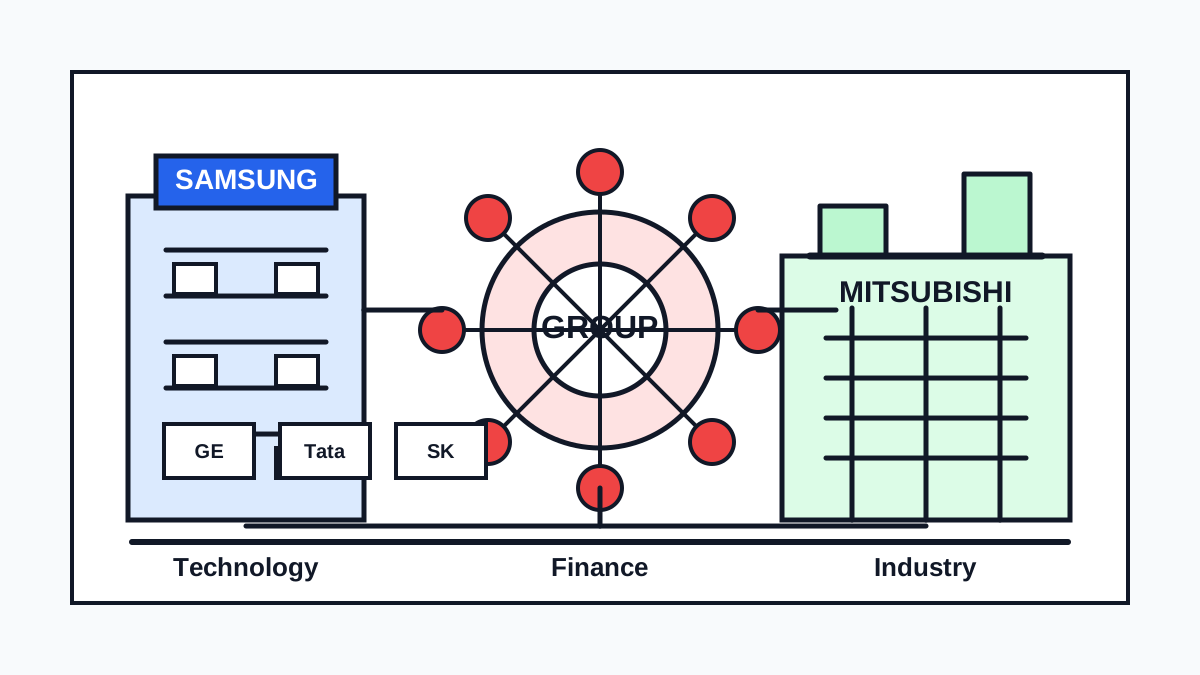
Calling Samsung an "empire" can sound like exaggeration. It is not a state, and it has no sovereignty, army, or tax authority. But if a company is viewed as a resource-allocation system, Samsung has long approached a form of "corporate state": it spans electronics, semiconductors, displays, finance, insurance, construction, shipbuilding, pharmaceuticals, hotels, and services; its products enter homes worldwide; its components enter the supply chains of other technology giants; and its investment cycles affect South Korean exports, capital markets, and employment expectations.
As of April 30, 2026, Samsung Electronics reported 2025 full-year revenue of 333.6 trillion won and operating profit of 43.6 trillion won. When South Korea's Fair Trade Commission designated large business groups in 2026, Samsung Group still ranked first, with total assets of about 695.8 trillion won. Samsung Electronics alone is already a core company in global technology. When Samsung Electronics, Samsung C&T, Samsung Life, Samsung SDI, Samsung Display, Samsung SDS, Samsung Heavy Industries, and others are viewed together, Samsung is not just a company. It is a main beam of South Korea's modern industrial structure.
There are not many companies like this. Prewar Japanese zaibatsu such as Mitsubishi, Mitsui, Sumitomo, and Yasuda; postwar Mitsubishi, Mitsui, and Sumitomo groups; 20th-century GE in the US; Tata in India; Hyundai and SK in South Korea all reached similar heights in their own countries. Their similarity is not that they were all rich. It is that they all possessed four features at once: coverage of key industries, control of capital entrances, alignment with national strategy, and organizational continuity across generations.
A real corporate empire is not just large. It can put a country's industrial upgrading, financial allocation, technology path, and political risk onto one balance sheet.
Why Samsung Is Special
Samsung's origin was not romantic. In 1938, Lee Byung-chul founded Samsung Sanghoe in Daegu, originally trading dried fish, groceries, noodles, and other goods. After the Korean War, Samsung entered sugar, textiles, insurance, securities, retail, and other industries. It entered electronics in 1969, moved into home appliances, shipbuilding, and construction in the 1970s, and bet on semiconductors after the 1980s, eventually becoming part of global technology infrastructure.
This path is not only an entrepreneur story. It is a product of South Korea's developmental state. Postwar South Korea lacked capital, technology, and markets. The government needed a small number of companies to carry export and heavy-industry breakthroughs, so it concentrated credit, foreign exchange, licenses, tax benefits, and policy orders in a few chaebol. Samsung, Hyundai, LG, and SK grew in that environment. They were both market competitors and executors of national industrial policy.
Samsung's special point is that it did not stop at assembly and branding. It entered capital-intensive technologies such as semiconductors and displays. There are many consumer-electronics companies, financial groups, construction groups, and trading groups, but very few companies simultaneously make global phones, TVs, memory chips, foundry services, OLED displays, battery materials, and enterprise IT services. Samsung's "imperial" nature comes from this deep vertical integration: it sells finished products and key components; it faces consumers and also Apple, Nvidia, data centers, automakers, and cloud vendors.
This gives Samsung rare cycle resistance. When the phone cycle weakens, memory chips may rise. When appliances face margin pressure, displays, HBM, enterprise SSDs, or foundry may become growth points. Failure in one end product does not necessarily collapse the whole group. The advantage of a group structure is that national-scale industrial cycles can be spread across departments. The cost is also obvious: when a core department makes mistakes, the impact can be amplified to the national level.
The Real Structure Of The "Empire"
Samsung is not a simple tree in which one parent company owns all subsidiaries. It is a typical chaebol network. Family control, cross-shareholdings, core listed companies, market value, insurance funds, internal transactions, and professional managers are interlocked. Outside investors see listed companies. South Korean society sees a group whose influence reaches far beyond listed-company boundaries.
The key is not that every company is directly owned by one legal entity. It is that control can be transmitted through a few key nodes. Samsung C&T, Samsung Life, Samsung Electronics, and related holdings have long acted as stabilizers of control. For the family, this reduces the cash cost of controlling the entire asset base. For the group, it allows long-term strategy to cross quarterly profit cycles. For minority shareholders and regulators, it creates governance complexity, related-party concerns, and inheritance disputes.
South Korean society's feelings toward Samsung are therefore complex. On one hand, Samsung represents Korean manufacturing, technological pride, and export capacity. On the other, it represents chaebol concentration, family succession, judicial privilege, and the shadow of political donations. Lee Kun-hee's "New Management" era moved Samsung beyond low-end manufacturing. Lee Jae-yong's era faces semiconductor competition, inheritance legitimacy, labor relations, supply-chain pressure between the US and China, and South Korea's long-running demand for chaebol reform.
Samsung is therefore not simply "too big to fail." More precisely, it is too deep to be treated like an ordinary company. Regulators cannot let it expand without limits, but they also cannot easily absorb a violent contraction. Investors want higher shareholder returns, but the state needs long-term capital expenditure. The public criticizes chaebol privilege, but also expects Samsung to support exports and employment in crises.
Mitsubishi: The Closest Prototype
If Samsung represents modern Korean chaebol, Mitsubishi is the classic East Asian prototype of a corporate empire. Mitsubishi began with Iwasaki Yataro's shipping business in the 19th century, grew under Meiji government support into one of Japan's largest shipping powers, and then entered mining, banking, insurance, warehousing, shipbuilding, real estate, steel, chemicals, and military industry. By the 1930s, Mitsubishi was one of Japan's two largest zaibatsu.
Mitsubishi's imperial nature was more direct than Samsung's. It had a financial core, covered heavy industry, served national strategy, and became part of the wartime military-industrial system. Mitsubishi Heavy Industries produced warships and Zero fighters; Mitsubishi Bank supplied capital; Mitsubishi Corporation organized resources and trade; Mitsubishi Mining and Mitsubishi Electric supported the industrial system. It did not expand outside the state. It became a tool inside state expansion.
After World War II, the US occupation authorities dissolved the zaibatsu. Mitsubishi headquarters was dismantled, shares were sold, and family control was broken. The postwar Mitsubishi group later regrouped as a corporate network, but it was no longer the centrally controlled family zaibatsu of the prewar period. Mitsubishi Corporation, Mitsubishi UFJ, Mitsubishi Heavy Industries, Mitsubishi Electric, Mitsubishi Chemical, Mitsubishi Estate, and others retained brand, history, and cooperation, while operating independently.
Mitsubishi shows one thing clearly: when a corporate empire is too deeply bound to military and colonial expansion, defeat or institutional reconstruction can interrupt its organizational form. Samsung and Mitsubishi are similar in that both grew with national development strategy. They differ in that Samsung's core binding is export manufacturing and civilian technology, not wartime imperial expansion. That is why Samsung remains a global brand today, while Mitsubishi mainly remains a corporate-group tradition.
Mitsui, Sumitomo, And The Japanese Zaibatsu System
Mitsui and Sumitomo are older and more deeply rooted than Mitsubishi. Mitsui grew from Edo-period commerce, finance, and trade. Sumitomo began with copper, smelting, and mining. Before the war, Japan's four major zaibatsu, Mitsui, Mitsubishi, Sumitomo, and Yasuda, covered finance, trade, mining, manufacturing, insurance, and heavy industry. Together they formed the skeleton of modern Japanese capitalism.
The strength of zaibatsu was placing banks, trading companies, and manufacturers inside one capital system. Banks provided long-term funding, trading companies organized international trade and resources, manufacturers upgraded industry, and controlling families maintained strategic consistency. This structure fits late-developing countries because it can concentrate resources when capital is scarce, markets are immature, and technology paths are uncertain.
The weaknesses were equally clear: capital allocation could serve family control rather than efficiency, internal transactions could weaken market discipline, political relationships could become entry barriers, and workers and smaller firms could lose bargaining power. Postwar Japan dissolved the zaibatsu not because they lacked efficiency, but because they concentrated economic and political power excessively and were deeply involved in the wartime system.
Postwar corporate groups and keiretsu relationships preserved some coordination advantages while weakening family control and central command. The names Mitsubishi, Mitsui, and Sumitomo remain, and banks, trading houses, and manufacturers still cooperate, but they no longer form complete corporate kingdoms as they did before the war.
GE: The Rise And Fall Of An American Corporate Empire
GE was another type. It was not a zaibatsu and not a family-controlled Asian group. It represented American managerial capitalism. In the 20th century, GE spanned power equipment, lighting, appliances, aircraft engines, medical equipment, financial services, media, and industrial systems. Its power came not from family and cross-shareholdings, but from professional managers, capital markets, R&D, and management methods.
GE's peak shows that the US could also produce something close to a corporate empire. It participated in electrification, aviation, medical imaging, defense, television media, and corporate finance, becoming in some sense a symbol of American industrial modernity. Under Jack Welch, GE became a global management model: diversification, Six Sigma, performance ranking, capital efficiency, and acquisition integration influenced a generation of multinational companies.
GE's decline shows that corporate empires do not always end because regulators break them apart. Sometimes complexity exceeds organizational capacity. GE Capital amplified returns during boom times and amplified risk during the financial crisis. Diversification provided stability during growth and became a discount during low growth. Management systems under short-term performance pressure could sacrifice long-term technology accumulation. In the 2020s, GE split into aviation, healthcare, and energy-related companies, effectively admitting that the universal industrial empire no longer fit capital markets and industrial competition.
The difference between GE and Samsung is that Samsung's complexity still revolves around manufacturing, chips, displays, terminals, and financial coordination, while GE's later complexity was heavily amplified by financialization. Samsung's risks are chaebol governance and technology cycles. GE's risks were management mythology and financial leverage.
Tata: India's Gentler Corporate State
Tata is another useful comparison. It grew from the 19th-century colonial Indian business environment and entered steel, power, hotels, automobiles, IT services, chemicals, consumer goods, telecom, and aviation. Tata Steel, Tata Motors, TCS, Tata Power, Indian Hotels, Air India, and others form India's most symbolic corporate group.
Tata differs from Samsung and Mitsubishi most in governance style. It has long emphasized trust ownership, professional managers, and social responsibility. Family influence exists, but it is not centered on narrow family succession in the same way as Korean chaebol. Tata Sons' major shareholders are charitable trusts, giving it an image of a nation-building enterprise in Indian society.
This structure also has two sides. Tata can carry Indian industrialization, national brands, and globalization, but its group boundary is also large, and internal coordination and capital allocation are not always efficient. Tata Motors' acquisition of Jaguar Land Rover, TCS becoming a global IT services giant, and Air India returning to Tata all show continuing national-level influence. But compared with Samsung, Tata controls less core technology; compared with Mitsubishi, it is less tied to military state machinery; compared with GE, it is more like a long-term social institution than a pure capital-market machine.
Hyundai, SK, And Korea's Second Tier
Within South Korea, Hyundai and SK are the closest comparisons to Samsung. Hyundai began in construction and shipbuilding, then split into automobiles, heavy industry, construction, shipping, and related systems. Hyundai Motor Group today plays a key role in automobiles, EVs, battery supply chains, robotics, and urban mobility. HD Hyundai remains a major global shipbuilding and heavy-industry force.
SK expanded from energy, chemicals, telecom, and semiconductors. SK hynix is a core global memory player and became more important in the AI era through HBM. SK Telecom is a key part of South Korea's telecom infrastructure. SK Innovation and SK On entered batteries and energy chains. SK's path shows that Korean chaebol are not only Samsung; energy, telecom, and semiconductors can also form national-scale enterprise systems.
Samsung remains special because it has both global consumer brands and upstream critical components. Hyundai is more concentrated in mobility and heavy industry. SK is more concentrated in energy, telecom, and chips. LG is more concentrated in displays, chemicals, batteries, and appliances. Samsung's coverage looks more like an industrial web stretching from living rooms to data centers and from phone screens to fabs.
Why Late-Developing Countries Produce These Groups
Samsung, Mitsubishi, Tata, Hyundai, and SK share a background of late industrialization. Late-developing countries do not start from a world where markets naturally produce optimal companies. Capital, technology, foreign exchange, talent, and markets are all scarce. If governments distribute resources evenly, no one may reach scale. If they concentrate support in a few companies, winners can quickly become giant groups.
This model has practical logic. Semiconductors, shipbuilding, autos, steel, petrochemicals, and power equipment require long capital expenditure and tolerance for losses. Short-term capital markets alone rarely complete the job. Large groups can use trade and financial cash flows to subsidize manufacturing, use government orders to reduce early risk, train engineers and managers internally, and smooth cycles through diversified income.
The problem is that structures useful in the catch-up phase become governance challenges in maturity. The larger a company becomes, the more it can influence policy. The more stable family control becomes, the more external shareholder rights can be suppressed. The more internal transactions there are, the harder true efficiency is to judge. The more a state depends on one group, the harder antitrust and industrial renewal become. A developmental-state tool can become a reform target after success.
This is why South Korea keeps debating chaebol reform. Without chaebol, South Korea would have struggled to move from a poor agricultural economy to a semiconductor, auto, shipbuilding, display, and consumer-electronics power in a few decades. But when chaebol become too strong, they squeeze small firms, labor bargaining, startup ecosystems, and political transparency. Samsung is both the answer and the problem.
Common Endings Of Corporate Empires
The fates of these groups roughly fall into four types. The first is being broken by war or institutional reconstruction, as with the postwar transformation of Mitsubishi, Mitsui, and Sumitomo. The second is being split by capital markets and management complexity, as with GE. The third is continuing as a group while being constrained by regulators, shareholders, and global competition, as Samsung, SK, and Hyundai are. The fourth is evolving into a long-term group with a public-institution character, which is closer to Tata.
Continuity depends on three questions. First, whether the core industry remains near the global technology frontier. If Samsung loses competitiveness in semiconductors and displays, scale alone cannot preserve prestige. Second, whether governance lets outside capital believe interests will not be consumed by internal networks. Third, whether the relationship between group and state can shift from policy dependence to institutionalized cooperation.
Historically, the most dangerous moment for corporate empires is often not failed expansion, but after successful expansion. Success gives them more resources and makes them harder for markets to discipline. Success makes the state depend on them and raises the cost of reform. Success makes family control look effective and lets succession risks accumulate.
Conclusion
Samsung deserves the word "empire" not because it sells many phones or has a large market value, but because it ties together South Korea's most important industrial capability, export capacity, capital-market imagination, and national technology path. It is a company, and also the result of industrial policy. It is a global brand, and also the concentrated expression of South Korea's chaebol governance problem.
Mitsubishi shows that a corporate empire can become a tool of state expansion and be dismantled by institutional restructuring. Mitsui and Sumitomo show that finance, trade, and manufacturing can help late-developing countries catch up, but also concentrate power. GE proves that American managerial empires can collapse under complexity and financialization. Tata shows a gentler, more socialized group tradition. Hyundai and SK show that the Korean model is not only Samsung, though Samsung pushed it to the most global and technological position.
The real question is therefore not "is Samsung too big?" A better question is: how large a group does a country need during industrial catch-up, and how large a group can it tolerate in maturity? When a company becomes large enough, it brings not only profit and employment, but institutional choices. The story of the Samsung empire is essentially the story of how late-developing countries concentrate power to catch up with the world, and how they handle that concentrated power after catching up.
Sources
- Samsung Global Newsroom: Samsung Electronics Announces Fourth Quarter and FY 2025 Results.
- Korea JoongAng Daily: Fair Trade Commission 2026 designated large business group classification, Samsung Group assets.
- Britannica Money: Samsung, Mitsubishi Group, Sumitomo Group, Zaibatsu.
- World Bank Data: Korea GDP current US dollars, 2024.
- Korea Fair Trade Commission reporting on large business groups and internal transactions.
Comments
Loading comments.