Business
Is Nvidia's Moat The Chip, Or The CUDA Ecosystem?
Nvidia's strongest position is not a single GPU or CUDA syntax itself, but the system that binds chips, networking, software libraries, developer habits, cloud vendors, and data-center delivery.
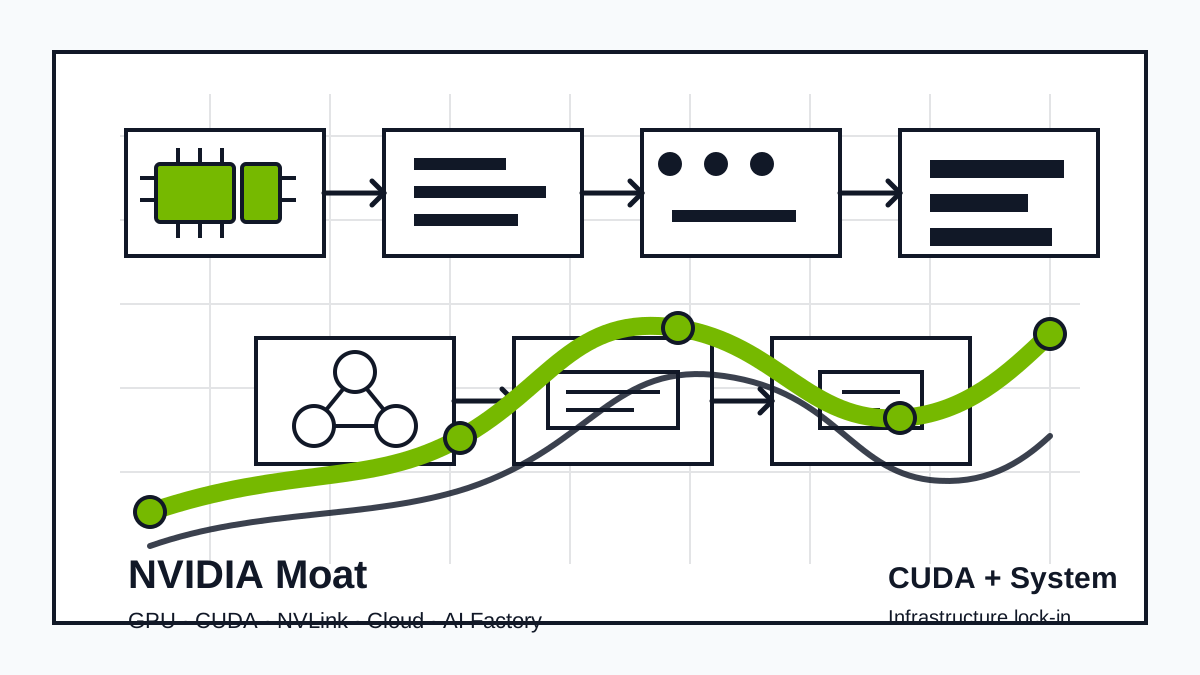
When people discuss Nvidia's moat, the common question is whether it is strongest in chips or in CUDA. The question itself is too narrow. Chips obviously matter; without fast, stable, mass-produced GPUs, the software ecosystem would not naturally exist. CUDA also matters; it has kept developers, frameworks, libraries, and enterprise workflows optimized around Nvidia hardware for years. But Nvidia today is not merely a chip company, and it does not lock the market only through one programming interface.
Its real strength is that it has turned "compute" into complete infrastructure: GPU, CPU, NVLink, InfiniBand, Spectrum-X, DPU, racks, power, cooling, drivers, CUDA-X libraries, NIM microservices, enterprise software, cloud instances, server vendors, and developer communities all sit inside one upgrade path. Customers are not buying a graphics card. They are buying the default solution already validated by model companies, cloud vendors, engineering teams, and capital-expenditure processes.
Nvidia's moat is not one brick. It is that anyone trying to route around it must rebuild chips, software, networking, supply chain, and developer trust at the same time.
Start With A Few Data Anchors
As of April 30, 2026, Nvidia's latest full fiscal year was fiscal 2026, ended January 25, 2026. Nvidia's results showed full-year revenue of 215.9 billion dollars, up 65%; data-center revenue was 193.7 billion dollars, up 68%. Fourth-quarter revenue was 68.1 billion dollars, with data-center revenue of 62.3 billion dollars. In other words, Nvidia is no longer a gaming-GPU company that also does AI. It is an infrastructure supplier centered on AI data centers.
Margins also show pricing power. Nvidia's fiscal 2026 GAAP gross margin was 71.1%, and non-GAAP gross margin was 71.3%. If this were ordinary hardware manufacturing, sustaining such margins would be difficult. Nvidia can do it not only because GPUs are powerful, but because customers buying Nvidia solutions buy shorter time to deployment, lower engineering uncertainty, a mature software stack, and higher cluster availability.
CUDA's history is longer. Nvidia's developer documentation describes CUDA as a platform beyond a single programming model and notes that since its 2006 launch, it has been widely deployed through applications, research papers, and more than 500 million CUDA-enabled GPUs. Nvidia's 2025 Rubin CPX announcement also mentioned an ecosystem of more than 6 million developers and nearly 6,000 CUDA applications. The meaning is path dependence: the more code, libraries, and engineering experience accumulate around CUDA, the higher migration costs become.
The product roadmap matters too. Nvidia's Rubin platform announcement defines the next AI platform as a coordinated system of Vera CPU, Rubin GPU, NVLink 6 Switch, ConnectX-9 SuperNIC, BlueField-4 DPU, and Spectrum-6 Ethernet Switch, and claims Rubin can reduce inference token cost by up to 10 times versus Blackwell. That claim still needs real deployment validation, but the direction is clear: Nvidia does not want the market to compare only individual chips. It wants competition to happen at rack, cluster, and data-center system level.
Chips Are The Entrance, Not The Whole Answer
Nvidia first won in hardware, and that should not be understated. The core bottleneck in AI training and inference is doing massive matrix computation within acceptable power, cost, and time. GPUs were designed for graphics parallelism and naturally fit many similar operations running in parallel. After deep learning emerged, that architectural advantage was amplified, and Nvidia kept adding Tensor Cores, HBM, NVLink, MIG, Transformer Engine, and other capabilities.
But "GPUs are fast" does not explain why Nvidia captures so much value. Many chips can approach or exceed Nvidia in certain metrics. Customers do not buy only peak performance. Model companies care whether training can finish reliably. Cloud vendors care whether clusters can be rented at high utilization. Enterprises care whether deployment, drivers, security, upgrades, and support will avoid unpleasant surprises.
The scariest problem in an AI data center is not that one card is slightly slower. It is unpredictable failure across the cluster. When tens of thousands of GPUs train together, networking, storage, cooling, power, driver versions, communication libraries, container images, and schedulers all affect final cost. Single-chip performance is the ticket to enter. Real value comes from reducing those uncertainties.
That is why Nvidia's products increasingly look like systems rather than parts. From Hopper to Blackwell to Rubin, it emphasizes not only GPU compute, but rack-scale interconnect, liquid cooling, networking, DPUs, security, inference services, and software tools. Customers can theoretically save some purchase cost by assembling hardware themselves, modifying frameworks, tuning communication, and fixing drivers, but they transfer engineering risk onto themselves.
CUDA Lock-In Is Not Syntax Lock-In
Many people understand CUDA as a language or API and draw a simple conclusion: if AMD, Google, Huawei, Cambricon, or another vendor builds a compatibility layer, CUDA's moat disappears. This underestimates the depth of the software ecosystem.
CUDA lock-in is not only whether code compiles. More important is that developers know how to tune performance, frameworks default to specific libraries, and PyTorch, TensorFlow, JAX, Triton, cuDNN, NCCL, TensorRT, CUDA Graphs, Nsight, and many third-party projects have formed default experience around Nvidia paths. When teams hit a problem, there are more online examples, more cloud images, more engineers in the hiring market, and more vendor support.
This lock-in resembles default standards in enterprise software. Alternatives can be cheaper or faster for some tasks in theory. But if migration requires rewriting kernels, retesting models, retraining teams, rebuilding monitoring, and redoing performance tuning, customers translate "cheap" back into engineering cost and project risk. For large model companies, one failed training run can cost far more than the hardware price difference.
CUDA's real power is translating hardware advantage into developer productivity. When a new GPU launches, if core frameworks, libraries, compilers, and inference services adapt quickly, customers can turn capital expenditure into usable compute faster. Competitors with chips but no equally mature software path must persuade customers to accept a longer burn-in period.
Of course, CUDA cannot be bypass-proof forever. Inference is easier to standardize than training, and cloud vendors and large model companies all want to reduce Nvidia dependency. Triton, ROCm, XLA, OpenAI Triton, compilers, and middleware layers all reduce the need to write CUDA directly. But that does not mean the CUDA ecosystem fails immediately. The higher the abstraction layer, the more someone underneath must make performance, drivers, and stability work. Nvidia remains the most mature in that layer.
The Real Moat Is The Full System
Nvidia's most important change in recent years is moving from selling GPUs to defining the AI factory. This is not a slogan change; it is a boundary change. Training and inference increasingly depend on large clusters. The larger the cluster, the less the bottleneck sits in one card, and the more it sits in communication, scheduling, power, cooling, storage, and failure recovery.
NVLink and NVSwitch solve high-speed GPU-to-GPU communication. InfiniBand and Spectrum-X solve cluster networking. BlueField DPUs offload networking, security, and storage tasks from CPUs. DGX and HGX provide reference architectures for server vendors, cloud vendors, and enterprises. NVIDIA AI Enterprise, NIM, NeMo, and CUDA-X libraries connect upper-layer application deployment. Each layer can be replaced in isolation, but together they create strong system stickiness.
This is the point of the Rubin narrative. Nvidia did not describe Rubin as just a faster GPU. It described it as an AI supercomputer made of six chip categories working together. It puts CPU, GPU, switch chips, NICs, DPUs, and Ethernet switches into one platform to reduce training time and inference token cost. Whatever the final realized numbers are, this direction means competitors cannot compare only one accelerator.
Customers often choose Nvidia not because it is cheapest in every local component, but because overall delivery is the most certain. Server vendors know how to integrate it. Cloud vendors know how to rent it. Developers know how to use it. Investors know how to estimate demand. Model companies know how to plan the next training run. Certainty itself is a source of premium.
Cloud Vendors Are Both Customers And Risks
Nvidia's largest customers are also the companies most capable of weakening it. AWS, Google Cloud, Microsoft Azure, Oracle Cloud, Meta, CoreWeave, and others buy large amounts of Nvidia hardware while also developing internal chips or custom systems. Google has TPU, AWS has Trainium and Inferentia, and Microsoft and Meta both have AI chip plans.
This means Nvidia's moat does not mean customers have no choices. The largest customers are least willing to be controlled by one supplier. They will use internal chips for some internal workloads and Nvidia for general training, frontier models, cloud customer instances, and ecosystem-compatible demand. For them, the ideal outcome is not to fully replace Nvidia, but to reduce some of Nvidia's pricing power.
But internal chips have real boundaries. Chip design is only the beginning. Compilers, framework adaptation, developer migration, cluster operations, yield, supply chain, customer support, and ecosystem promotion follow. Internal workloads can be deeply customized, but external cloud customers prefer general, familiar, portable environments. Cloud vendors will erode part of Nvidia's profit pool, but in the near term they are unlikely to turn Nvidia from the default option into an ordinary supplier.
The larger risk is demand cadence. If AI infrastructure investment runs ahead of real revenue, cloud vendors will cut capital expenditure. Nvidia's current revenue depends heavily on data-center expansion. If model training scale, inference monetization, enterprise AI budgets, or financing conditions change, growth will be affected with leverage. A moat protects competitive position. It does not guarantee cycles will not reverse.
China Restrictions Shrink The Market, Not The Ecosystem Itself
Nvidia also faces geopolitical risk. In April 2025, the US government required export licenses for H20 products to China. Nvidia recorded 4.5 billion dollars of H20-related inventory and purchase-obligation charges in fiscal Q1 2026 and said another 2.5 billion dollars of H20 revenue could not ship that quarter. Q2 results also showed no H20 sales to China customers.
These restrictions directly affect revenue and accelerate China's effort to build domestic AI chips and software stacks. The less stable China's access to high-end Nvidia chips becomes, the stronger the incentive to invest in Ascend, Cambricon, Hygon, Biren, and other local hardware and adaptation ecosystems. Long term, the global AI compute market may split: one part continues around CUDA and Nvidia, while another rebuilds around local hardware, policy constraints, and domestic software stacks.
But substitution is not simple copying. Domestic chips must challenge not one GPU generation, but CUDA, NCCL, cuDNN, drivers, framework adaptation, developer experience, cluster networking, server supply chains, and cloud service ecosystems. Restrictions create substitution demand, but they do not automatically create substitution capability. The larger the training cluster, the more visible system gaps become.
So China restrictions have a dual effect on Nvidia: they reduce the addressable market in the short term and cultivate regional alternatives over the long term. But in mainstream global AI training and cloud services, Nvidia still holds a strong default position. What it loses is not the moat itself, but access and growth elasticity in some markets.
How The Moat Gets Eroded
The most likely way Nvidia weakens is not one sudden "better GPU." It is simultaneous substitution across layers.
The first layer is inference cost. Training needs extreme performance and stability, while inference emphasizes cost per token, latency, power, and deployment convenience. As distillation, quantization, sparsity, specialized inference chips, and edge deployment mature, some inference workloads will move away from high-end GPUs. Nvidia is also actively optimizing inference, which shows it knows growth cannot rely only on training.
The second layer is software abstraction. If developers increasingly call compute through PyTorch, Triton, XLA, ONNX, MLIR, or managed cloud services, underlying hardware differences are partly hidden. Hardware independence will not eliminate performance differences, but it lowers psychological migration barriers. Nvidia must keep making its lower-layer implementation faster, more stable, and easier.
The third layer is large-customer internal chips. Hyperscale clouds and model companies will move the largest and most stable internal tasks to custom chips to reduce cost. Nvidia will still serve high-end general demand and external customers, but part of the profit pool can be removed.
The fourth layer is capital-expenditure discipline. If AI application revenue does not match infrastructure spend, customers shift from "grab compute" to "calculate ROI." Nvidia may remain the strongest supplier, but order growth and valuation narratives will be repriced. A moat is not infinite demand, and technical leadership does not replace customer cash flow.
The Answer Is Not Chip Or CUDA
If one sentence is required, Nvidia's moat is "chip capability amplified by CUDA." More accurately, it is the default path for AI infrastructure created jointly by chips, software, and system delivery.
Chips give Nvidia the performance starting point. CUDA keeps developers and frameworks on its platform. Networking and rack-scale systems move it into data-center architecture. Cloud and server vendors make it a purchasable, deployable, scalable standard. In isolation, each layer has competitors. Together, they are what makes Nvidia hard to replicate.
This moat will not remain unchanged forever. Inference-specific chips, internal accelerators, open compilers, geopolitics, and capital-expenditure cycles will keep wearing against it. But in 2026, challenging Nvidia is still not as simple as building a good chip. The harder question is: when customers are ready to spend billions or tens of billions of dollars building AI data centers, can you turn compute into usable productivity faster, more reliably, and with lower risk than Nvidia?
As long as the default answer to that question remains Nvidia, the moat remains.
Comments
Loading comments.